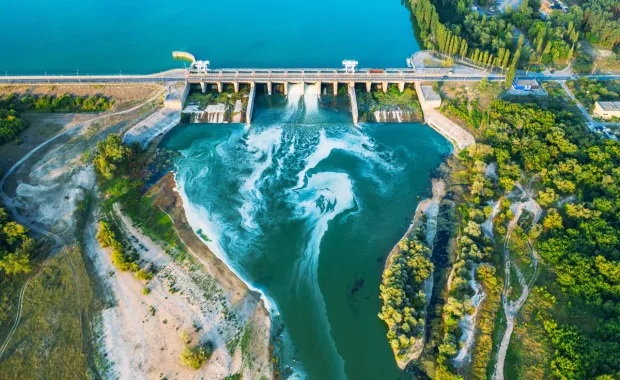
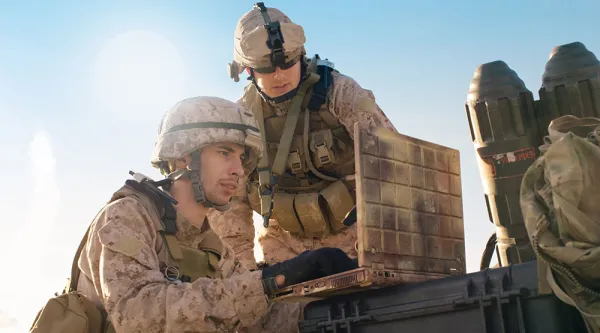
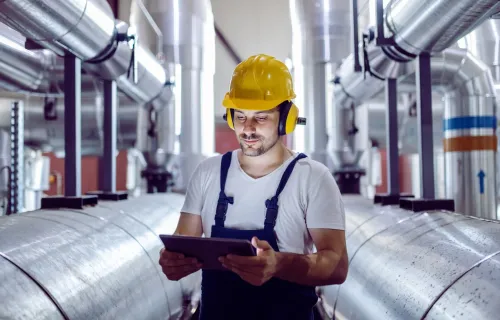
Peter describes IT/OT integration as the “cardiovascular system” of national infrastructure, supporting everything from energy grids and industrial control systems to water networks and transportation. Historically, organizations maintained separate IT and OT security functions, often with separate security teams, governance models and priorities.
Today, that separation has become a liability. Attackers exploit the gaps between systems, moving across supply chains and organizational boundaries to find the weakest link.
The discussion reflects a broader shift away from periodic, compliance-based security toward continuous, enterprise-wide resilience. Cybersecurity is no longer a departmental function or a box to be checked. It must be embedded into systems from the outset and governed as a unified capability, spanning infrastructure, operations and leadership.
That integration sets the foundation for how artificial intelligence is reshaping situational awareness. Rather than relying on retrospective analysis after an incident has occurred, AI enables organizations to focus attention where it is needed most, in real time. Machine vision and predictive tools can identify patterns, anomalies and risks as they emerge, reducing noise and accelerating response.
Instead of asking people to sift through overwhelming volumes of data, intelligent systems surface the single image, signal or event that requires immediate action. The result is not automation for its own sake, but decision support that allows humans to act faster and with greater confidence.
Speed becomes a defining characteristic of sovereignty in this environment. Drawing on defense decision-making models, the conversation highlights how advantage increasingly belongs to those who can observe, decide and act faster than their adversaries. Data has little value if it arrives too late to influence outcomes.
This emphasis on speed extends beyond defense into civilian infrastructure and crisis response. Real-time, contextual data supports faster recovery from extreme weather events, equipment failures and supply chain disruptions. Systems that combine historical insight with live conditions help organizations anticipate needs, allocate resources and adapt continuously, rather than reacting after the fact.
Data itself is treated as a strategic asset rather than a byproduct. The ability to share information securely across organizational and national boundaries, without relinquishing control, emerges as a critical enabler of modern ecosystems. Rather than wholesale data exposure, the focus is on governed exchange: granting access to specific data for defined purposes, supported by policies, checks and balances.
This approach reflects a growing recognition that supply chains are no longer linear. They function as dynamic ecosystems that must be monitored and adjusted continuously. What once took weeks to assess can now be understood instantaneously, changing how organizations manage risk, inventory and continuity.
The conversation also reframes the relationship between resilience and sustainability. Rather than competing priorities, they are presented as mutually reinforcing. Efforts to improve resilience often drive innovation that reduces emissions, improves efficiency and increases self-sufficiency, particularly in constrained or remote environments.
Across the discussion, a clear picture emerges of sovereignty in transition. Energy, defense and digital infrastructure are no longer separate domains. Control now depends on integrated security, trusted data exchange and the intelligent use of technology to support faster, better-informed decisions.
- 1. Digital sovereignty, AI and the digital backbone of national resilience
-
Derek Marinos:
Welcome back to Energy Transition Talks. I'm Derek Marinos, your host. In this second episode, we turn to the digital backbone that supports modern sovereignty — the systems that connect, protect, and power national infrastructure. We'll explore how AI, cybersecurity, and digital trust define readiness in an increasingly complex world. Back with our guests, Peter Warren and Torsten Bernstrom.
Peter, I'd love to start with you on this one. What makes IT/OT integration — and that's information technology and operational technology — the cardiovascular system of national infrastructure?
- 2. IT/OT integration as the foundation of cybersecurity and sovereignty
-
Peter Warren:
It's a great question, and thanks for asking it. It's a concern of many federal governments right now. And it comes down, in the case of provincial and state and local legislation... For a long time, it was sort of this: “I got a rubber stamp. I did it. I've made it secure.”
Now it's becoming: “No, you will comply, and in some cases use the federal tools.” This is moving down, and the reason for this is: with IT/OT integration, they're the points of attack.
When you look at the various attacks that have happened in the energy industry, phishing still is the number one thing — human manipulation. The other one is coming at the infrastructure, and it's always about finding the weakest link. Some attacks have been going to a manufacturer that has a backdoor into their system, that then has a backdoor into the OT department, that then crosses into IT, and so on.
Stan Sims — he's retired from CGI, but he was our former security officer and he transformed the way we do security in CGI, and we continue to evolve that. One of the parts he brought forward is that if you have a separate IT security team and a separate OT security team, you have no security, because you have to have a unified approach.
And that's a bit controversial in the industry because CIOs and operations people say, “No, this is my fiefdom.” My belief, based on what Stan — with many years in the Pentagon and other places — taught me, is that you really have to treat this as one unit. Fragmentation is not good. It becomes a weak point.
Even if you have experts looking at different parts of it for obvious reasons — because there are differences — there must be communication, a construct, and organizational structure to it. And that's how we operate as CGI all the way up to the board of directors, knowing what roles they are, right down to individual members having to actually do certain things.
Security isn't a departmental thing — it certainly isn't anymore. And if it is in a company, they really need to have a hard look at what they're doing.
- 3. Cybersecurity by design in critical infrastructure and defense
-
Derek Marinos:
And Torsten, I'm hearing Peter here and echoing Stan's comments, and just... somehow cardiovascular and fractured — that just doesn't seem to or doesn't work here. I'm guided by this. Could you share your perspective on that as well?
Torsten Bernström:
First, thank you, Derek. Back to Stan Sims — great mentor — and he also said, beside the OT/IT statement, that you really need to work with security all along from the first day. Security cannot be bolted on; it has to be baked in — baked into every solution.
I, for myself, like the term “cardiovascular system” when it comes to everything that has to do with IT in the supply chains and the total defense. Because I sometimes get the question: “Yeah, but you are representing the defense arena… What do you know about water supplies or energy?”
And I would say: nothing in today's society works without the zeros and ones in our IT system. Even if you have water from your faucet or energy in your light bulb, that is governed by the IT systems.
So for a malign force — a foe from a state actor or some terrorist — you would go for the IT systems. That's where you will make the most harm. And that's actually a frightening scenario, but something we need to be vigilant and steadfast for every day.
- 4. Artificial intelligence and predictive maintenance for system resilience
-
Derek Marinos:
Agreed and understood. The holistic approach is vital. Understanding that those zeros and ones are part of everyday life—and mean more than just the sum—is vital. And that leads me to my next question: when you see zeros and ones, it's more than just that. How can AI and predictive maintenance enhance system resilience, Peter?
Peter Warren:
It's in a wonderful spot. I see leaders in this—several companies. ExxonMobil, publicly, they've published things; they are very active. I see them as a leader in this in the world.
But you see other companies in other parts of it — even airports and rail. I've been pulled into these conversations. It's very much about having an as-designed viewpoint of what you have, an as-built current image of things, but then a real-time overlay of what's happening.
Using an example — not an energy one, but an airport one — they were very good at looking forensically at what happened. They could tell, when they went back and watched all their cameras, that this person kept going to this area, kept coming back again, and that's how they gained access where they weren't supposed to go.
What we can now do with machine vision and tools and software is actually not necessarily send 20 minutes of video for someone to figure out, but the photograph you need to be concerned with right now. The AI says: “This is the thing you should be concerned about right now.”
And it's not just facial recognition — some places you can't do that — but by stature, walking, pattern, who they are, not as an individual (“not Derek, not Peter, not Torsten”) but this person has repeatedly come back to this spot, even though they've changed clothes. Or they're an employee not wearing equipment, or they're a visitor not wearing the right equipment.
These are things you need to know now to avert a problem or threat, versus looking back forensically and saying: “Okay, we can rewatch the video and see what we did wrong last time.”
- 5. Data-driven defense and decision advantage
-
Derek Marinos:
The outs of prevention, Torsten.
Torsten Bernström:
Yeah. Today we're talking about data-driven defense. It's been a slogan for quite a while, but now it's really happening. The amount of data you can take in from sensors — it's huge.
The possibilities are that with artificial intelligence and predictive algorithms, you can really speed up the decision process — which in military terms is the OODA loop: observe, orient, decide, act. Whoever gets that wheel to turn faster than your adversaries will win.
AI and predictive algorithms, and automation, make you move faster and sort out unnecessary data — finding the golden nuggets. It gives you the possibility to really go in circles around your opposition.
- 6. Data sovereignty and crisis response in a connected world
-
Derek Marinos:
Wonderful, Torsten. And you're providing a great segue to our second block — looking at data, and more specifically: has data become the new form of sovereignty? How does data enablement support sovereign decision-making in crisis response, Peter?
Peter Warren:
It goes back to what we just talked about. Forensic data is nice, but that's history. You need systems telling you what’s happening right now.
We have to have humans in the middle — we're the ones that act. We're not suggesting we abdicate responsibility. But we can combine things in a form for humans in a way we haven't done before.
Given all the history — say it's a storm. Last time a storm like that hit us from here, these are the things that fell down, broke, inventory you should have, staff you’re going to need, contractors you should call. Either you remember that or look it up — or the system bubbles that up for you automatically.
Further: this just broke. When that breaks, you should do these things. Helping the person be better.
Our energy people — we’re no longer replacing like-for-like one-for-one in the energy industry. You just can't get all the same people. Skills are changing. People are being demanded to do many more tasks than before.
Systems are needed to support these folks. Plus, there's a generational thing: younger people demand that those tools exist, that they're in the palm of their hand, that they bubble up the process — starting with safety first.
And that’s where I see this industry moving forward rapidly. And that is all data — local data, based on our policies, procedures, best things, manufacturers’ best processes — not generic viewpoints from another part of the planet. It's very personal.
- 7. Global perspectives on resilience and supply chain ecosystems
-
Derek Marinos:
And Torsten, coming from where you are across the pond — do you see that same perspective globally? Because what Peter's describing seems to be the blueprint moving forward.
Torsten Bernström:
Of course. Everybody's on their feet now, trying to put all the supply chains together — all the aspects of resilience. The total defense concept, with all its aspects of having all parts of society working together — that's a given. Yes.
Peter Warren:
To quote one of our clients who spoke at one of our internal meetings: his company used to look at their supply chain once every four years — not because they needed to, but because they thought they should.
It's now a weekly thing. Their suppliers are attacked by pirates, impacts in oil, tariffs, everything. It's now a key function of ongoing business.
It's not a linear supply chain — it's an ecosystem. Given everything I have now, what are the strings I can pull to fill that need? It’s a dynamic function.
And you mentioned too: the first time he asked what his inventory looked like, it took six weeks to tell him what his global inventory was. Now they know instantaneously. That's the power of data.
- 8. Trusted data exchange across borders and alliances
-
Derek Marinos:
Very important point. And Peter, you've given me a thread to pull on. How can nations retain control of their data while collaborating globally?
Peter Warren:
For me, it's about exchanges. We do this already today in banking. We move data in the form of banking every day between people who don't know each other, don't like each other, don't trust each other.
It crosses borders, exchange rates, policies, legislations. Competitive markets to socialistic markets and back. It’s all based on policies, procedures, checks, and balances.
It's not exposing my banking data entirely — I'm giving you access to this piece for this reason, for this purpose, and it's going to change ownership. That kind of model is where we’re heading in our ecosystems.
Derek Marinos:
Torsten — how might you extend that to other industries?
Torsten Bernström:
The operative word here is speed. Information is only valid for a short time. For decision makers in a military loop, the information that is “now” is the valuable one.
How should we store data when alliances shift? Like Peter said, it's about transfer of data, checks and balances — but the operative word is speed.
- 9. Sustainability, resilience and the future of defense
-
Derek Marinos:
Speed — very important.
I'd like to move on now to sustainability versus resilience. Can defense ever be low-carbon, or is resilience the real sustainability?
Torsten Bernström:
Torsten here — I would say there is no conflict. It's two sides of the same coin. Resilience and sustainability…
In the long run, our efforts now to have a more sustainable and resilient society — look at what we can do to be more stable or more sustainable to threats — in the long run, that leads to innovative solutions that make us more carbon neutral, more efficient with Earth's resources, more agile in materials we use. This works to our advantage as a human race.
Derek Marinos:
Yeah, two sides of the same coin, Peter. Your perspective?
Peter Warren:
There's a belief that militaries run only on dinosaur juice — and that's a lie. They are big adopters of innovation: electric vehicles, even electric motorcycles.
If you're in a battle, you can’t always get gasoline out to the field, but if they've got their own solar panels, they can juice these things locally. Sustainability in conflict: run radios off solar, not have to supply batteries. The old WWII supply chains aren't always required.
The military is looking to decarbonize — not just because it's the “right thing,” but because it's the best thing tactically. Better to have solar panels. Better to purify water in the field using solar and battery than send a diesel truck.
So there is a move toward this — for tactical reasons, not only social ones.
- 10. Readiness, resilience and the evolution of sovereignty
-
Derek Marinos:
Thank you, Peter. Across our conversation, one truth stands out: sovereignty is evolving. Energy and defense, once separate domains, now depend on one another to secure not just our borders but our way of life.
Resilience has become the foundation of progress, and readiness — both physical and digital — is the measure of true security.
I'd like to thank both Peter Warren and Torsten Bernstrom for joining us for another installment of Energy Transition Talks. I'm Derek Marinos, your host, and until next time, stay resilient. Goodbye for now.