



Why health and life sciences need Vital Signs: Setting the stage for transformation

In the inaugural episode of Vital Signs, CGI’s new podcast series for health and life sciences leaders, host Ben Goldberg, Global Industry Lead, sits down with Dr. Diane Gutiw, Vice-President of AI and Analytics at CGI. Together, they explore why the podcast was created, what CGI is hearing directly from industry leaders, and how emerging technologies, especially AI, are reshaping healthcare when applied with purpose, discipline and empathy.

The conversation centers on execution: how organizations move from pilots to production and deliver measurable outcomes in complex, human-centered systems.

Smarter decisions through accessible innovation

Across health and life sciences, innovation is accelerating, but not because data and analytics are new. As Diane explains, the sector has relied on advanced analytics, machine learning and diagnostic imaging for years. What’s changed is accessibility.

Natural language interfaces and generative AI are bringing data closer to clinicians and administrators, making insights easier to surface and act on. Tasks that were once complex, expensive and time-consuming, such as parsing unstructured clinical notes or narrative data, are now more feasible at scale.

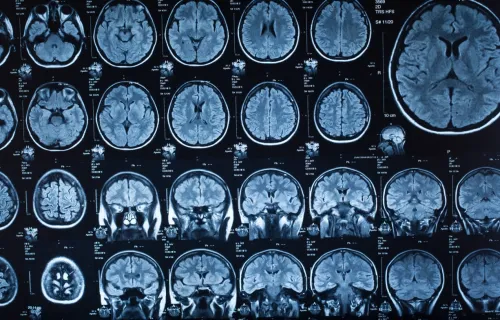
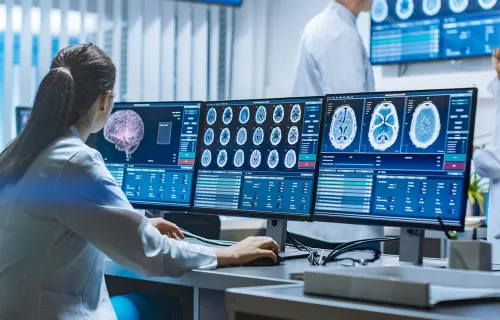
This shift enables tangible gains, from e-scribing that reduces clinician documentation burden, to faster and more accurate diagnostic imaging that helps detect conditions like early brain bleeds or cancers sooner. At the molecular level, AI is also accelerating drug discovery, diagnostics and personalized treatment protocols.

From experimentation to impact: focusing on value

Despite rapid innovation, many leaders feel they are falling behind. Diane notes that this anxiety often stems from an overload of pilots and proofs of concept that never reach production.

The key, she argues, is to stop leading with technology and start leading with the problem. Organizations must ask: What are we trying to solve? and Does this tool create real value—more efficiently or at lower cost—than existing approaches?

Successful adoption also depends on change management. AI is not a shortcut for critical thinking, nor is efficiency “cheating.” The real challenge lies in integrating tools consistently, embedding them in workflows, and fostering a culture that balances innovation with accountability.

Adoption challenges: scale, foundations and human impact

One of the strongest signals CGI is hearing through our Voice of Our Clients research is that organizations struggle to scale AI beyond early experimentation. Common barriers include:

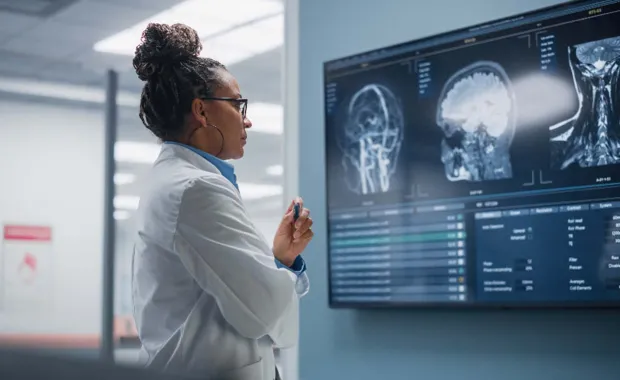
Health professional examining xrays
  • Policy and risk concerns, with uncertainty around safety, governance and acceptable use
  • Data and infrastructure readiness, which limits the ability to deploy solutions at scale
  • Workforce anxiety, including fear of job loss or discomfort shifting from “doing the work” to supervising intelligent tools

In healthcare, these concerns are nuanced by workforce shortages. The opportunity is less about replacement and more about enabling professionals to do more with limited resources, while preserving clinical judgment, empathy and trust.

Global patterns: AI as an expert partner, not a replacement

Across regions and systems, a consistent pattern is emerging: clinicians want AI to augment, not replace, their expertise.

Diane highlights CGI’s work with Helsinki University Hospital on Head AI, which supports radiologists by flagging potential early brain bleeds with over 99% accuracy. The radiologist performs the initial review, then uses AI insights as a second expert opinion, improving both accuracy and learning over time.

Similar principles apply to referral pathways, where AI helps reduce inappropriate referrals and testing, speeding patient access to the right care while easing system strain.

The CGI difference: proximity, collaboration and cross-sector learning

A defining strength in CGI’s approach is its proximity-based delivery model. Teams work within the same communities and healthcare systems as their clients, understanding local constraints while connecting them to global insights.

By facilitating collaboration across jurisdictions and across industries, CGI helps clients learn from proven models rather than operating in silos. As Ben explains, lessons from healthcare inform other sectors, and vice versa, especially in areas like predictive analytics, forecasting and operational efficiency.

What’s next: performance, applied AI and smaller models

Looking ahead over the next year, Diane points to several trends gaining momentum:

Health professional examining xrays
  • Model performance and efficiency, driven by the cost and scale of AI compute
  • Applied AI, focused on high-value use cases embedded directly into workflows
  • Small, domain-specific language models, designed for expert-level performance in healthcare and other industries

As organizations move more pilots into production, agentic AI—capable of handling multi-step tasks—will play an increasingly important role. But success will hinge on disciplined value assessment and rethinking how work gets done.

Leader takeaway: innovation must become core to how we work

Diane closes with a clear message for senior leaders: using AI is inevitable, but value comes from how it’s used. Efficiency is not the end goal, it’s a launchpad for deeper analysis, creativity and better decisions.

Innovation, she argues, must move from the edges to the core of how organizations operate—guided by purpose, scale and human judgment.

Vital Signs is a new CGI podcast series exploring the real signals shaping transformation across health and life sciences. 

Read the transcript

Chapter 1: Why health and life sciences need Vital Signs: Setting the stage for transformation

Ben Goldberg:

Hello, I'm Ben Goldberg, Global Industry Lead for Health and Life Sciences, and welcome to Vital Signs, a new podcast from CGI, where we unpack what's really happening across health and life sciences. So, in this series, we're going to explore the signals of transformation that matter and whether it's how organizations are using AI to solve complex problems, how they're modernizing outdated systems, or even how they're navigating real-world constraints like funding, workforce, and trust. But it's not just about technology, it's about execution and equity and outcomes. And let's be honest, there's no shortage of transformation talk out there, but what's often missing is the how, not just where we're headed, but how we get there in systems that are complicated and messy and deeply human. And that's where vital signs comes in. So, each episode, I'm to speak with experts and clients and partners who are truly in it. People solving the hard problems with urgency and focus, and we're going to keep it honest. These aren't polished keynotes, they are real conversations about what's working, what's not, and what's next.

And today is a very special edition as it's our official kick-off episode. And we're going to talk about why we launched this show, what CGI is hearing directly from health and life sciences leaders and what we hope this podcast is going to spark. And to help me do that, I'm privileged to be joined by a friend and colleague, someone who I've worked closely with for years now, Dr. Diane Gutiw, our Vice-President of AI and Analytics at CGI. She brings an incredibly grounded view of how innovation actually shows up in hospitals, ministries, research labs, and boardrooms. Diane, thank you for being here. Welcome to Vital Signs.

Diane Gutiw:

Thanks, Ben. I'm really excited in having this conversation with you and chatting about what we've seen evolving over these last few months. Because, as you know, all of the technology we're talking about here, as well as the uses of technology, have really evolved rapidly. And we're seeing some fantastic stories where ourselves, our clients, and our partners across industry are doing some really amazing things in the healthcare life sciences space, as well as in the social sector.

Chapter 2: Smarter decisions through accessible innovation

Ben Goldberg:

Fantastic. So, I tell you what, before we actually dive in, let's set the stage. So, tell me, what are you seeing across health and life sciences clients right now? What signals are really rising to the top?

Diane Gutiw:

Yeah, you know, I think we're seeing a lot of innovation happening very quickly because a lot of these technologies, the use of data for decision making, is not new to health life sciences as well as the social sector. We also see a huge opportunity because not just the new technologies in generative AI and agentic AI, but we're also seeing the ability to use data and to streamline data and make the answers to questions more accessible to clinicians and health administrators and operators of solutions so much more accessible with the tools that we have now.

Diane Gutiw:

You know, I think in health and life sciences, the reason why we're seeing innovations happening so quickly is they're not dependent just on the new technology. We have been using data, we've been using machine learning, advanced analytics for years, as well as a lot of really great advancements in deep learning related to diagnostic imaging and other areas of diagnostics treatment protocols. So, it's not new in this industry and we now have a fantastic new tool in our toolbox that is, while it's not new that we're using data, we now can do things like parse images quicker. We are able to parse narrative text, which is something we'd always wanted to be able to do easier, and it's really complex, expensive, and time-consuming to model narrative data in a way that you can get the best value out of it.

The other thing that's really shifted is the accessibility of these tools. You know, the natural language front end has really moved the mark in bringing data closer to clinicians and healthcare administrators, and in a way that makes it very useful. We have all the same questions that other industries have around transparency because a lot of these solutions are a bit of a black box, as well as the reliability of the outputs, but the industry is keeping up with those questions, and we've seen some great advancements there.

To your question, where are we moving the mark? It comes back to, where are there problems that we need to solve? One would be resource capacity. So, finding tools that help us do more with less to be more efficient. Things like e-scribing have really taken off, where we can use technology to be able to not just record a conversation, but intelligently transcribe a conversation from natural language and chart it in a chart. And we've seen some really great advancements in e-scribing and moving that mark forward with these latest technologies in agentic and generative AI. Another area where there's some fantastic advancements would be in the area of diagnostic imaging.

Diane Gutiw:

AI is a brilliant tool to be able to see things that are hard to see, minute changes that are hard to see with the human eye. So being able to screen quicker for things like early brain bleeds, different types of cancers, and move the screening up so we're catching things much sooner is another great advancement. And then lots of things happening at the molecular level when in drug discoveries and diagnostics and treatment protocols that are helping us personalize medicine, personalize treatment protocols, and advance everything from vaccine to drug discovery. So, it's a really fascinating time to be watching the industry. And if you ask me tomorrow, I'll have new examples.

Chapter 3: From experimentation to impact: focusing on value

Ben Goldberg:

It is fancy. It is fascinating. It's also, it's a technology that's so consequential in an industry that's been ripe for disruption. And I wonder, because it's almost like leaders are feeling that they're under pressure as they're also standing on the edge of some of this real opportunity. Why do you think that might be the case?

Diane Gutiw:

Well, everyone thinks they're behind, right? I know you and I go to a lot of meetings and part of the first conversation is, “I think we're falling behind.” There's lots of reports also coming out which are questioning the value of the technology. Is the bubble about to burst? Are we getting real value? And I think it's a good moment to take pause and focus on value and say, again, what is the problem I need to solve? Where are there strategic priorities that I can get ahead of?

Diane Gutiw:

And rather than leading with the technology, I need to do more AI. It's, you know, I've got these issues that I need to look at. Do I now have a tool that's going to make that easier, more cost effective? Can I find a new way of doing? You know, I think as well, we're starting to realize, you know, you can't just throw tools at a problem. You know, we definitely see that there's a benefit to people that are using these tools for efficiencies and automation of manually intensive tasks. But if you're not using the tools consistently, if you're not integrating them in the right place, that cost-benefit balance of, know, is this something really I should automate or should I be doing this, versus is this something that I really should be doing, or can I find an easier way? And then there's a mindset, a culture, you know, it's not cheating to be more efficient. It is cheating not to be a critical thinker, right? And finding that balance. And these are all change management problems. So, we need to integrate change management. We need to change our culture to be less risk-averse and more innovative, and find the sweet spot where these tools will actually help us, versus the cost of consumption and the cost of AI compute, because that is something we need to pay attention to.

Chapter 4: Adoption challenges: scale, foundations and human impact

Ben Goldberg:

That's huge. It's funny. mean, I was going to go down the path of what you think is not being said enough, but I think it's those nuances that really need to be highlighted. It's not so much about just lumping technology in. I think there's also some foundational pieces that people need to consider as well, because throwing technology onto bad data is a garbage in, garbage out situation. There's a lot of foundational components, and be it from a change management perspective or just your overall governance. I think those are some pieces. Are there any others that you think maybe need more attention that we aren't focused on enough?

Diane Gutiw:

Yeah, you know what we've seen in our Voice of Our Client and for anyone listening, CGI every year interviews top leaders and executives across different industries, both our clients and organizations we may not be working with, yet. And what we're hearing is they're still stalling out—a lot of the investigations and playing with the tools and building pilots and proofs of concepts—they're still stalling out before they're going into production.

When we're asked the reason for that, a lot of the time there's either policy constraints that are saying, we're not sure of this technology yet. Is it safe for use? What risks are we opening up in using these technologies? And we don't have a clear template for walking through that yet, would be one. And then the second is you need a foundation. While these are low-code tools, you need a foundation both in your data management and in your infrastructure to be able to scale these.

So, you might have a lot of one-offs that have gone out that are showing value, but in order to get the real value, they need to scale. And the other thing I hear over and over again is fear of job loss. You know, people are worried that if I automate all of these tasks, do I still have a job? Slightly different nuance, I think, in the healthcare industry because we are addressing a huge resource capacity issue.

Diane Gutiw:

You know, so how do we redo what we're doing again to do more with less is more of a focus. But I do think there's a lot of fear, both in changing how I do things, from being the person that did the work to being the operator of a tool doing the work, which is a shift. And then I think there still is a fear of, “if I'm going to do this, what am I? If I'm to get a tool to do this, what am I going to do?”

Chapter 5: Global patterns: AI as an expert partner, not a replacement

Ben Goldberg:

Yeah, it's interesting. I think that there's definitely that concept of job loss with automation. And there is still some of that in health and life sciences, too. Like I think of radiology clinics, right? And I think of radiologists reviewing patterns with an imaging that AI can fundamentally transform and make simpler. But that doesn't mean that you don't need that educated eye in the end, that radiologists actually be reviewing the imaging and provide some sort of a conclusion. Maybe on that note, because you and I, we function globally, we’re working with teams and clients all around the world. What do you think some of the common patterns or insights are that kind of connect those different experiences, despite the differences in geography or structure or mandate? What's some of the commonality out there?

Diane Gutiw:

I think some of the commonality of how we work with tools and where we're seeing the benefit, and radiology is a really good example, is people don't want to replace what they're doing. They want to make it easier. So, in radiology, if we look at Head AI, for example, which is work that CGI is doing in partnership with Helsinki University Hospital, and has really shown over, I think, 99% accuracy in detecting early brain bleeds. The workflow speaks to how we want to use these tools in the future. The radiologist does the first read, and then they get additional information and insights from the AI solution. It serves two purposes. It provides that expert advice to, “this is what I'm seeing and what did I maybe miss” or “how could I look at this differently,” as if you were consulting with another expert.

It also is teaching. You know, if there's something new, a new way of looking at it that the AI is able to see, is that actually going to improve the quality of what you're doing over time? Another great example that we're working with clients on is referral pathways. You know, and the problem that they're leading with is inappropriate referrals that waste time for the specialist or for the service or the treatment.

It's taking up time from getting treatment from patients if they go down a wrong pathway and have to then get back in the queue for a different type of referral or treatment or diagnostic tool. So, creating tools because we have this wealth of information that are advising the general practitioner or the intern or the specialist on based on this, this is the appropriate timing. This is the appropriate order and priority. And this is where I would take this next is really giving more information to the clinician and speeding up the time because we're avoiding these inappropriate referrals, inappropriate tests, or having to redo tests in a different order.

Chapter 6: The CGI difference: proximity, collaboration and cross-sector learning

Ben Goldberg:

I think it's a true global reality that there's opportunity for efficiency savings within health and life sciences. So that's a really great case study. I love that. You mentioned about the VOC, which is something near and dear to CGI's heart or Voice of Our Client. How else do you think that CGI approaches these opportunities that really helps us listen and respond in a way that's different from others?

Diane Gutiw:

You know, with CGI, we have such a great model for, you know, proximity-based delivery. So, we have people on the ground that are working in the same communities as our clients. And that doesn't change for health care. So you know the nuances of what are the challenges in that jurisdiction, where are there opportunities and really understand we are clients of the system that we're working within as well in health and life sciences.

But we also have the range of industry expertise. We have the ability to connect the dots to, you know, “you have a challenge here… this is being solved… you know, let me pull in…” and an openness to sharing. So, I think that that's really important. And we've seen some great opportunities where we've actually brought clinicians and healthcare administrators from one jurisdiction to another where there's a common problem. And we're connecting our clients with others that are struggling through the same issues so that they can collaborate better.

So, information sharing, communication, understanding the context, and then having that knowledge of what's going on elsewhere that may be relevant is some really great value to have those tight networks.

Ben Goldberg:

I love that. I think that's one of my favorite parts of the job, actually is that that cross-, you know, regional collaboration that we can do within our roles. Cause it's, huge. You've got other regions that have proven out models that others can learn from, rather than just focusing within their silos. So, I think that's massive. yeah.

Diane Gutiw:

Well, and it's a matrix, right? Because we're even seeing outside of healthcare, where some lessons learned and what we've been doing in healthcare are helping things like predictive maintenance and forecasting, and, you know, and vice versa. You know, it's amazing the commonalities, particularly when we're looking at that the use cases for AI or how can we use data to make better decisions that we're able to learn across this matrix of, you know, who's doing this elsewhere to be more efficient. So even in what we're doing, we're looking at these efficiencies.

Chapter 7: What’s next: performance, applied AI and smaller models

Ben Goldberg:

Yeah, well, I do. I often talk about the overlap that we have with other industries, you, from a payer perspective, in with financial services or insurance, or from a life sciences perspective, where manufacturing fits in for pharma tech, or from, you know, any of the med tech builds. So, there's a lot that can definitely be leveraged in our view helps provide that. I love that.

I have a question for you. I need you to get your crystal ball out, but what signals or trends do you think you're watching closely? Let's say over the next six to 12 months. And if it's AI, great. Or maybe even digital front doors, workforce resilience, platform maturity, where do you see things going?

Diane Gutiw:

Yeah, great question, Ben. You know, we're looking ahead to where researchers are focusing. And we're also looking ahead to where the industry demand is. And some of the things that we're seeing coming up in the next year, I think we're going to see more focus on performance. And I don't mean just efficiencies. I think we're going to see that as well, but performance of these models, performance in the model efficiency, because we need to pay attention to AI compute and the huge capacity of AI compute infrastructure power that's needed for the volume, because these tools are so accessible. So, on the efficiency as well as on the capabilities.

We're seeing models now that are able to do things that solve some really complex tasks and problems in a much more efficient way, and the reliability of those responses increasing. So, I think performance is one area where we're going to see a lot of investment. Another will be the applied AI. You know, where are there real efficiencies? How do I rethink how I'm working using these tools so that I can do things in a more efficient, more productive way? Lessons learned on where is that sweet spot. Where do I want to apply this? Where does the human stay involved? Because we need our context, our empathy. We need a person to be asking the questions so the tools can give us the answers. So, the workflows and applied AI, I think, is somewhere that we're going to see a lot more.

And then the other area, which I've seen a little bit, but I think it's going to happen out of necessity, is small language models. Models that are not large language models that are focused on being able to answer questions based on the full knowledge of all the Internet, small language models that are focused on industry specific needs that are not trained on what's the best restaurant for Italian food in Toronto or how do I learn French in six months and become fluent, which are great uses of the tools by the way. Models that are specific and really are expert advisors in healthcare and in manufacturing, robotics, oil and gas. I think we're going to see more attention on these small language models that are fit for purpose, that are a wealth of knowledge within a realm, that will answer the question on performance as well, because they will perform better in that small capacity.

So, think that somewhere we're going to see some changes as well. When it comes to the use of the tools, I predicted last year that we would see the floodgates open for these pilots moving into production. I think we are I'm seeing that people are now starting to move forward thoughtfully. You know, they're starting to look at tools more like agentic, which are able to do more than one interaction with the tools. And you're able to automate the tasks that make sense. So, I think agentic is going to take off more and more because that's where we're seeing the value.

And then there’s the word value, looking at where are the high value use cases and looking at the cost benefits of implementing these tools versus doing it the old way. And in order to do that, we do need to rethink how we work.

Chapter 8: Leader takeaway: innovation must become core to how we work

Ben Goldberg:

That's huge. It's a great segue because I'd like to kind of end on a bit of a reflective note. And I'm looking to see if you could give one piece of advice to a CIO or a senior leader that's maybe just starting out on their digital transformation path. Though I doubt many are. Many are probably in that midterm POC, you know, proving the value. But what kind of guidance and what kind of advice would that be at this point?

Diane Gutiw:

I think my advice at this point, it would be focused on value and scale, right? It would be, now that we know that the use of the tools is becoming inevitable, know, people are using the tools in their personal capacity, they're getting more familiar with how to prompt the tools and have interactions with tools to get more quality responses. And we need to lean on that innovative mindset across how we work.

I've told this story a few times, but I'm going to tell it again because I don't think it gets old, which is my son is in third year university. So, he hit his academic career in the cusp of all of these technologies being introduced. And in his first year, everything had to be handwritten because there was so much fear over the use of the tools and the fear, you know, it was considered cheating. If you use a generative AI tool to help write your paper, you are cheating.

The second-year university was, you can go back to digital, but we know if you've been using the tools. We're going to look at your keystrokes. We're able to use our plagiarism tools that already exist to see, you know, what percentage likelihood you use these tools. And if you use the tools, you're cheating. This year, I've seen a shift. And the shift is his assignments are more like, go do your policy analysis and use the tool of your choice. Come back with the analysis coming from the tool. And then in bold letters, that is not your assignment. I am going to teach you how to peer review. I am going to teach you how to check the sources. And I'm going to teach you how to use these tools to be able to improve. And all of this is launching research off of existing knowledge. So, this will then launch what you do next. And that's taking an undergraduate program and doing what we learn in graduate school on launching research from existing knowledge.

And to me, that type of thinking, it is inevitable that we are using these tools. It is not cheating to be efficient. However, you need to put a creative lens on it. You need to use this to launch your real work. And that's the mindset we need to get into if we want to be a culture of innovation. We need to shift to that mindset. My son hates that I use his example every time, but it's been a great little guinea pig case study I have for how this is shifting. I'm heartened to hear that's how we're educating this next generation on how to use the tools.

Ben Goldberg:

Yeah, it's actually a very welcome openness. So that is nicely reassuring. Well, I appreciate that Diane. And thank you so much for your time. I'm going to conclude here.

I think that's a great way of closing off our first episode of Vital Signs. And just to let people know, we've got a full season ahead, unpacking the real challenges and signals that are shaping transformation across health and life sciences, from AI adoption to workforce pressure to platform modernization.

In our next episode, actually, we're going to be diving into what we refer to as the two-speed transformation, which we see playing out across the sector, and what it takes to close that gap. And so maybe for the listeners out there, this has sparked something for you, please feel free to subscribe, follow us along on LinkedIn, and of course, feel free to share.

But until then, we will see you next time.