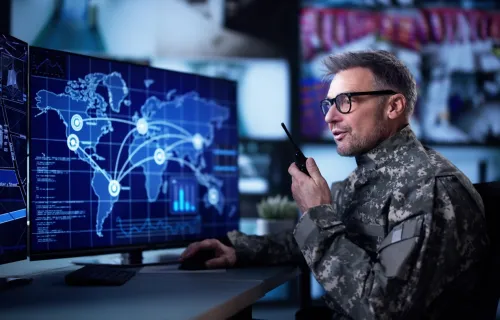
Early military inventions—such as the stirrup that kept knights in the saddle, casting technology that allowed for higher cannon loads, or industrialization that shifted the ability to wage war from the battlefield to factories and supply lines—have all been milestones in human development. They often led to mainstream changes as well as to breakthroughs and successes in warfare.
Civil information technology is the force multiplier of our time
Over the past two decades, civilian information technology has had a profound impact on the modern battlefield. What we see in today’s conflicts is that civilian technological development has become a key success factor and a force multiplier for the defense sector.
Traditionally, there was a clear division between civilian and military spheres. But today, that boundary is increasingly blurred. Civilian companies provide cloud services, analytical tools and security solutions that are now used directly in warfare. These services are well established in civilian industries, even if they were not originally designed for military use.
Likewise, technologies and systems that were once developed exclusively for military applications have increasingly been augmented by civilian innovations.
Smartphones, social media, commercial satellites, drones and artificial intelligence are just a few examples of civilian technologies now playing a direct or indirect role in modern warfare.
These innovations have brought a new level of speed and efficiency to the battlefield, sometimes faster than even trained professionals can fully manage. They have enabled breakthroughs in stagnant combat environments and created faster decision cycles through automation and advanced analytics.
As a result, across the chain, from sensors to strategy, military organizations and those who work within them must change their behavior and mindset to act effectively in today’s conflicts.
Collection, analysis and information sharing are key
One of the most decisive impacts of civilian information technology is the ability to collect, analyze and share information in real time. Commercial drones can be used for reconnaissance, open-source intelligence (OSINT) can provide insights about the opponent, and civilian communication platforms used for coordination have become arenas where the information war is fought.
The battlefield is no longer confined to physical terrain. It now extends into the digital domain. Whoever can most quickly gather, interpret and act on information has a decisive advantage. Some might say that has always been the case. Speed in staff work has always been crucial. True, but today’s difference lies in the sheer volume of information that military personnel must process, coming not just from subordinate or superior units, but from all participating entities simultaneously.
Behavioral changes and adaptation
To keep pace with this evolution, military professionals and citizens must adapt.
1. A higher level of digital competence
Defense organizations need greater digital literacy not only among IT specialists, but also among soldiers and officers. They must understand the basics of cybersecurity, source criticism, information influence and data flow through digital systems.
Military staff must understand which information is critical for analysis and decision-making, and which data must be extracted to make the right call at the right time. This is a major challenge that demands much from individuals and has far-reaching implications for the entire organization.
2. A changed culture around information sharing
What is posted on social media can reveal positions, troop movements or strategies. Everyone, including civilians, must understand that digital footprints can have serious consequences. This means that information discipline must be integrated into training and routines.
3. Integrated cooperation between defense and industry
The development of defense systems and command methods must occur in close integration with the private sector. Defense development agencies cannot move fast enough, capture the latest innovations, match operational needs or sustain the ecosystem of partnerships required for ongoing innovation.
Global IT service providers are already established in allied nations, ensuring integration and interoperability of systems and operations. These companies already possess civilian systems and may provide the missing capabilities military operations need to achieve decisive success.
CGI as a partner to NATO allies and total defense
CGI’s 2025 Voice of Our Clients research highlights that collaboration remains a defining priority for the sector: half of defense and intelligence organizations plan to increase their operational and capital expenditures to accelerate modernization, while 85% have already adopted AI strategies to enhance decision-making and mission readiness. At the same time, 95% still face medium to high legacy challenges, showing that true transformation is not only about adopting new technology, it demands new ways of working and partnering across the civil-military ecosystem.
At CGI, we partner with NATO allies to strengthen and advance their digital capabilities, and regularly participate in knowledge hubs, panels and exhibitions where security issues and defense cooperation are discussed. The NATO Summit, NATO Edge, Almedalen, Defence Expo, and DSEI are familiar venues for us.
Connect with me to learn more about how we support NATO’s defense community and our work with clients to help them be at the forefront of digital defense innovation.
About this author

Daniel Isberg
Director, Consulting Services – Defense & intelligence
Daniel Isberg is one of CGI's experts in defense, security and intelligence analysis. As a former officer and manager in the Swedish Armed Forces, he has extensive experience in operational and strategic work in Sweden and in international operations within NATO.