As artificial intelligence technologies rapidly mature, AI agents are becoming increasingly powerful. On their own, each adds powerful capabilities for executing tasks. When combined, they create multi-agent systems that unlock true value and enable autonomy at scale. This is agentic AI.
AI agents are now aligned horizontally to priorities such as preventing fraud, waste and abuse or enhancing cyber capabilities, and vertically to specific industries including healthcare, financial services and government.
This evolution from the “Trough of Disillusionment” to the “Slope of Enlightenment” is helping create a new frontier in operations that government agencies can, and should, leverage now.
Speeding implementation through an AI catalog
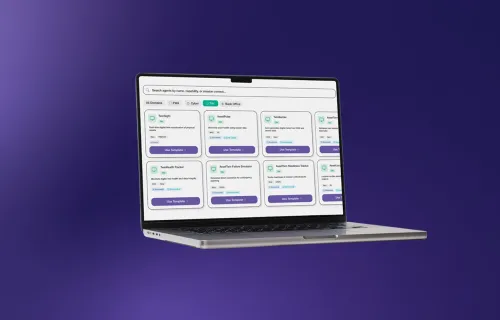
Imagine a catalog of thousands of curated AI agents, each laser-focused on a specific pain point, task, need, or operational inefficiency.
When agency leaders want to deploy an AI agent to thwart ransomware, identify fraudsters or track every asset across their enterprise, they can pick the perfect agent off the shelf, plug it into an application and derive value in days and weeks, not months or years.
Nimbleness and agility in AI solutions for federal agencies
AI agents at this scale will accelerate true digital transformation and create new operational paradigms, while creating new pressure points for governance and workforce readiness.
One of the standout features of these advanced AI solutions is their remarkable agility and adaptability for federal agencies. This flexibility is crucial for enabling agencies to tailor their technological tools to their specific priorities, most pressing needs, and budget constraints.
A catalog of curated AI agents benefits government agencies in several important ways:
- Customizable selection: Agencies can choose from a diverse range of AI agents, each designed to address different aspects of their operations. No matter the focus—improving housing services, for example, or detecting anomalies in immigration applications—agencies can select or create the agents that best meet their current objectives. This customizable approach ensures that the technology is directly aligned with the agency's mission and goals.
- Scalability: Agents are designed to scale and avoid vendor lock-in, allowing agencies to start with a few key tools and expand their use as needed. This scalability is particularly beneficial for agencies with limited budgets or those looking to pilot new technologies before committing to a full-scale implementation. As the agency's needs evolve, it can seamlessly integrate additional agents, ensuring continuous improvement and adaptation.
- Cost-effectiveness: A loosely coupled, lightweight catalog enables agencies to prioritize investments based on their most urgent needs and available resources. This enables strategic funding allocation, ensuring the most critical areas receive the necessary technological support without overextending the budget.
- Rapid deployment: This approach is designed for quick, easy deployment, minimizing the time and effort required to integrate agents into existing systems. This rapid deployment capability enables agencies to start benefiting from the technology almost immediately, addressing urgent challenges and labor shortages and improving operational efficiency without significant delays.
- Adaptability: AI agents are adaptable and technology agnostic, capable of evolving with the agency's changing needs. This ensures that agents remain relevant and effective over time, providing long-term value and avoiding technical debt.
Agents and agentic AI accelerate mission enablement
As federal agencies grapple with mounting cyber threats, back office demands and opaque asset chains, mission-focused AI agents are emerging as game changers.
Applied to complex challenges such as cybersecurity, fraud detection, asset visibility and administrative overhauls, they can slash inefficiencies while supercharging decision-making at enterprise scale.
Some common use cases for AI agents include:
- Cybersecurity: AI agents function as tireless digital sentinels, detecting threats more swiftly than any human team. They continuously learn patterns, enabling them to address vulnerabilities before hackers can exploit them. This translates to powerful capabilities such as real-time intrusion detection across networks, automatic malware quarantine and predictive analytics to prevent attacks. This proactive approach replaces reactive measures, providing peace of mind.
- Fraud, waste and abuse: Detecting FWA requires meticulously analyzing extensive datasets, including contracts, invoices and claims, to identify anomalies such as duplicate payments or fictitious vendors. By carrying out this analysis and cross-referencing procurement records with live audits, AI agents can significantly reduce fraud losses. These agents act as incorruptible watchdogs, ensuring financial integrity.
- Total asset visibility: AI agents can track every asset an organization owns using radio frequency identification (RFID), the Internet of Things, blockchain and similar technologies. They predict maintenance needs, optimize asset deployment and automate recalls. This comprehensive oversight ensures that assets are utilized efficiently, maximizing budgetary resources.
- Back-office transformation: Administrative functions such as human resources, finance and procurement are ideal use cases for AI agents; they can recommend hires, reconcile accounts and draft policies swiftly. Agents can handle natural language queries while maintaining high efficiency, reducing manual processes from hours to minutes, allowing employees to focus on high-value tasks.
- Tech stack capabilities: Ideal for augmenting, enhancing and optimizing technical functions such as edge computing deployment, cloud services and data management, AI agents accelerate technical debt reduction.
- Public housing programs: Subsidized housing programs entail a complex mix of data collection and exchange across federal, state and local agencies. AI agents can help locate affordable housing, monitor compliance with grant programs, manage tenant services and enact complaint resolution.
- Protecting and managing natural resources: AI agents support resource management by providing services such as wildfire-risk forecasting and expedited permitting for new data centers and nuclear reactors.>
AI agents not only optimize operations but also redefine government service delivery, making it more secure, efficient and mission ready.
Learn more: Artificial intelligence agents for federal missions | CGI United States
Learn how CGI is empowering federal agencies for AI benefits
Vision to Value: Accelerating AI Implementation in Federal Agencies
Register to access the webinar on demand, featuring expert panelists from CGI Federal, IDC, AWS, and Georgetown University discussing AI integration and agents in government. IDC Analyst Max Claps provides IDC's latest research on enabling and optimizing mission outcomes through agentic AI, followed by a panel discussion on adoption trends and strategies to overcome AI implementation barriers.
About this author

Karim Fadel
Vice President
Karim Fadel leads CGI Federal’s artificial intelligence (AI) go-to-market strategy and business development for the Regulatory Agencies Programs business unit.