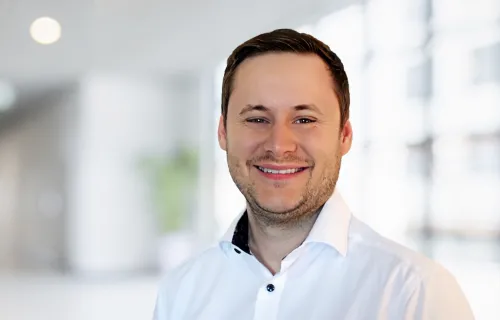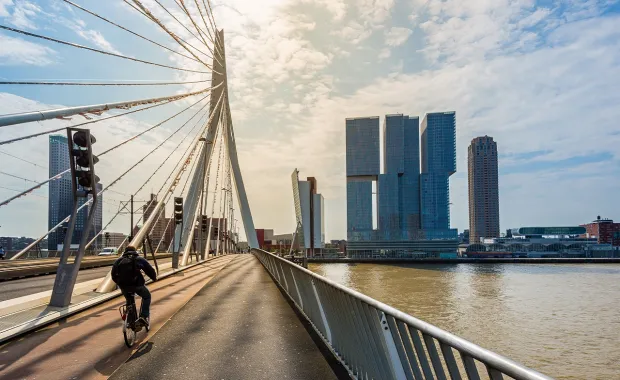

Henk van Haaster is a data and analytics leader based in Rotterdam in the Netherlands. Twenty-five years into his career at CGI, he still applies a runner's mindset to his work in innovation: the moment you stop moving, you start falling behind.
To begin, how did you get your start at CGI?
I joined in 2001 as a PeopleSoft consultant at CMG before the company merged with CGI. This was straight after completing a bachelor’s degree in Management, Economics and Law. At the time, I believed careers were built from carefully planned steps. But just a few months after I joined, the market changed dramatically following the events of September 11, 2001. Projects were put on hold, and demand wasn’t the same. The world had changed, and I had to adapt. That’s when I decided to build my technology skills.
That's a big shift to navigate early on. What came next?
An assignment with a major casino operator in the Netherlands introduced me to business intelligence (BI). I discovered that I had a real talent for working with data and business consultancy. My mentor saw that demand for BI was growing. He told me, "Data is the future," and encouraged me to pursue it.
It turned out to be a very accurate prediction and a piece of career advice that has shaped my professional journey ever since.
How has that early BI grounding shaped the work you do today?
For years, BI was mostly about looking backward: understanding what had already happened and explaining the past well. Today, the work has flipped forward. It's less about explaining yesterday and more about anticipating tomorrow. It’s about using AI and large language models not just to describe what happened, but to help people decide what to do next, responsibly and with judgment. That shift, from BI to AI, from hindsight to foresight, has defined the second half of my career.
Tell us about the work you do now.
For the past six years, I've helped build iAMLAB, CGI's innovation team in the Netherlands, focused on areas such as knowledge graphs, data spaces, immersive technologies and AI. It’s a group of curious, multidisciplinary colleagues who spend their days doing something genuinely unusual: building solutions to problems that didn't exist as problems a year ago.
It's not R&D in the abstract sense. We work directly with the various stakeholder teams to understand the problem and its context, then experiment and validate ideas quickly. One way we do that is through a "high-5," a five-day sprint that brings business and development teams together to test a specific challenge. Within a week, we can usually see whether an idea has potential and, sometimes, that first experiment becomes something much bigger.
Can you give us an example of how this approach was applied to solve a client challenge?
One example started with a high-5 two years ago. A client responsible for infrastructure assets needed a better way to understand the condition of those assets and prioritize maintenance and replacement. Much of the information they needed was buried across a huge volume of unstructured documents, making it impossible to retrieve manually at scale.
We used the high-5 approach to test whether AI could extract the relevant information. The initial experiment worked, so we continued developing and testing the solution in short cycles. Two years later, it’s now moving into production.
You're also a runner. Does that connect to how you think about the work?
I think about the work the same way I think about running: the moment you stop moving, you start falling behind. Innovation isn't a project with an end date. It's a mindset: staying curious, staying uncomfortable, refusing to assume that what worked last year or even last month still applies. This mindset is indicative of CGI’s culture and it genuinely guides how the work feels, week to week.
Why has CGI been the right place for that kind of work?
Plenty of places will tell you they value collaboration. What's kept me at CGI for 25 years is that the collaboration is real; not just something people talk about. We have short lines of communication with people willing to actually move something forward rather than just discuss it.
Are there specific initiatives that demonstrate that spirit?
I saw this most clearly in two things I helped build that weren't part of my job description. One was CGI Next, a network for young professionals that I helped establish. It gives CGI Partners in the Netherlands opportunities to connect, learn and share experiences across the industries we serve. What started with a few national events has grown into a community of around 500 CGI Partners, with several committees and events both nationally and within sectors.
The other was our involvement with Delft Hyperloop, a student-led initiative to develop a climate-neutral, hyperloop system. We made a deliberate choice not to just write a sponsorship check, but to show up and contribute real expertise. We connected the students with people in our network who understand infrastructure and transportation, and worked with the team to create a virtual reality environment called the Station of the Future, which helped them explore how the concept could affect the built environment. To me, that is typical of CGI: creating impact through expertise and collaboration.
After 25 years, what keeps you here?
I still enjoy this job, not because it went according to plan, but because it never did, and CGI kept giving me room to build the next thing. Whether that's a new technology, a new team, or just connecting the right people around a shared problem, there's always an opportunity to “build what’s next.” For me, that isn't just our 50-year milestone theme. It's just what the work has actually been, year after year.
Is there anything else you'd like to add?
Just one fun fact. This is a big milestone year for both CGI and me. I turned 50, CGI celebrates its 50th year in business worldwide, and I mark 25 years at CGI. It wasn’t planned that way, but it makes this year feel particularly special.
Thank you, Henk, for sharing your inspiring career journey at CGI!