
Explore key topics in this article
- Stablecoins – a store of value or payment rail?
- Stablecoins vs. tokenized deposits: A critical distinction
- Where tokenized money actually works today
- What stablecoins do not solve
- Stablecoins – from payment rails to liquidity systems
- Why stablecoins are not well suited for retail payments today
- The coming arbitrage era: Lessons from high frequency trading
- Implications for banks, corporations, and central banks
- Closing perspective
Stablecoins are often described as the future of money. With more than $300 billion in circulation today and projections ranging from $2 to $4 trillion by 2030, they are attracting increasing attention from banks, regulators, and investors.
With demand growing, investment in stablecoins is accelerating, with several new developments in the market. An American Banker survey found 47% of banks report client interest in general crypto information, 35% in making crypto payments, and 27% in institutional custody1. However, despite rapid growth in supply and transaction volumes, there is limited publicly available, auditable evidence that stablecoins are meaningfully penetrating beyond crypto markets into mainstream payments.
In 2025, stablecoin networks processed approximately $35 trillion in total on-chain volume. However, the vast majority of this activity reflects trading, liquidity management, and internal transfers within crypto markets rather than payments. When these flows are isolated, real-world payment activity is estimated at approximately $390 billion or roughly 0.02% of global payment activity2.
Even within that $390 billion, usage is concentrated in specific segments. Business-to-business payments account for roughly $226 billion (around 60%), with the remainder spread across remittances, card-linked spending, and niche consumer use cases. Even in B2B payments and remittances, stablecoins remain a drop in the ocean. In other words, stablecoins are growing, but primarily within institutional and crypto-native contexts, not everyday retail payments.
This does not diminish the significance of stablecoins as an emerging financial instrument. Rather, it highlights that their current utility is concentrated in specific contexts that differ materially from mainstream payment systems. Most observable volume continues to flow through centralized exchanges where stablecoins function primarily as liquidity staging instruments for crypto markets – effectively acting as “crypto-dollar parking spots” between trades rather than as a medium of exchange. An example would be when someone sells Bitcoin and converts it to something like Tether (USDT), USD Coin (USDC), or until they decide to deploy those funds into another crypto asset.
At the same time, the regulatory landscape is beginning to formalize. The US implemented the Genius act in July 2025. In Canada, the government has introduced draft legislation and is working on a stablecoin framework expected to be in place in 2027.
As regulatory frameworks mature, stablecoin issuers are increasingly being required to hold high-quality liquid reserves, maintain capital buffers, and support reliable redemption under stress conditions. This is notable because it pushes stablecoins closer to bank-like balance sheet structures. As a result, the distinction between stablecoins and tokenized deposits becomes less about technology and more about legal structure and trust.
This leads to a fundamental question:
Do stablecoins represent a new form of money or simply a tokenized representation of value already held elsewhere?
Stablecoins – a store of value or payment rail?
Stablecoins in their current form are not widely accepted as a payment medium by merchants and businesses. As a result, they function primarily as a stored-value instrument used for transfers or shortterm holding, rather than as a means of payment. In order to operate as a true payment instrument, there need to be more intuitive, frictionless on-ramps and off-ramps – essentially, it must be easy and inexpensive to buy, use and sell them; otherwise, the expected efficiency and benefits vanish.
More fundamentally, stablecoins rely on some form of redemption and fiat settlement to complete any real-world transaction. They also carry a distinct risk profile – they can carry counterparty and liquidity risk (issuer solvency, reserve backing, redemption capacity) which is very different from the risks associated with bank deposits.
Stablecoins represent a logical continuation of long-standing treasury and liquidity management innovations. Moreso than a new settlement paradigm. What many are skeptical of is the narrative that stablecoins are an imminent replacement for money, retail payments, or existing payment rails. The reality is more nuanced.
Stablecoin use cases
Stablecoins have a small number of immediately viable use cases today. Those use cases are real, valuable, and commercially meaningful, but they are primarily institutional, closed loop, and treasury oriented. In practice, their current usage aligns more closely with treasury instruments and, in many respects, tokenized deposits with a focus on liquidity movement rather than end-user payments.
Several of these use cases are not unique to stablecoins. They reflect broader demand for real-time, crossborder, and always-available liquidity movement; capabilities that are also driving the development of tokenized deposit solutions within the banking system.
Digital asset exchanges and markets
Used as the primary value transfer instrument to buy, sell and move value between crypto or tokenized assets without relying on fiat funding and bank payment rails.Internal treasury movement across global business units or platforms
Enables companies operating across multiple countries to reposition funds quickly without waiting on banking cut-offs.Off-hours and cross-time zone transfers outside of banking and payment scheme hours
Allows value to be moved on evenings, weekends, or across time zones when traditional payment systems are unavailable.Programable payouts
Used in scenarios where funds are distributed automatically based on predefined rules or external triggers. While often associated with stablecoins, this capability reflects broader trends in payment orchestration and programmability and is not unique to tokenized money.Faster cross-border transfers between payment providers
Used by payment providers and fintechs to move value between countries with greater speed and control than traditional correspondent banking, particularly when managing timing, cut-offs, or funding constraints.
These use cases are primarily operational, and liquidity or cash management focused, rather than consumer payment scenarios.
Stablecoins vs. tokenized deposits: A critical distinction
One of the most important distinctions that is often blurred in public discourse is the difference between:
- A token representing a bank deposit, and
- An asset backed security or instrument issued outside the deposit framework.
A tokenized deposit is a digital token that represents money already in a bank account; it is simply a digital representation of a claim on a regulated bank balance sheet – a claim on deposits. The legal claim, credit exposure, and regulatory treatment remain anchored to the deposit itself. The token is a new form factor for moving value. It is not a new asset class. In this sense, tokenized deposits represent digitally native bank money, whereas stablecoins represent digitally issued claims on reserve assets. From a risk perspective, this is fundamentally different from an asset-backed stablecoin, which relies on reserves, custodians, redemption mechanics, and issuer solvency.
This distinction matters because deposit tokens inherit the trust framework of the banking system: prudential regulation, capital requirements, liquidity coverage, supervision, and established resolution regimes. Asset backed stablecoins do not, no matter how well constructed they may be.
For this reason, most credible bank-led initiatives today are best understood as tokenized deposits operating within proprietary or permissioned networks – not open, retail payment instruments. Bank ledgers are not global, and they do not settle instantly.
Tokenized deposits also avoid a structural challenge emerging in stablecoin markets: fragmentation. Because they represent regulated bank liabilities rather than privately issued tokens, they maintain a single unit of account anchored to the banking system rather than multiple competing instruments tied to the same currency.
Where tokenized money actually works today
The strongest, most immediate use cases for stablecoins and deposit tokens are institutional:
High-value institutional use cases
Treasury and liquidity management:
Moving liquidity across legal entities, branches, and regions on a 24x7 basis – including non-business hours, weekends and holidays.Intra-bank and inter-affiliate settlement:
Effectively extending the business day beyond wire, EFT, and RTGS cut-off times.Cross border wholesale flows:
Reducing reliance on correspondent banking for specific corridors.Collateral mobility:
Rapid movement of value to manage margin, settlement risk, and liquidity buffers.Increased capital availability:
An alternative to pre-funded accounts, they can release capital for other uses (opportunity cost).
In this context, stablecoins function less like a payment rail and more like treasury plumbing. They compress settlement cycles, reduce operational friction tied to time zones and cut-offs, and improve liquidity efficiency. They do not eliminate forex (FX), funding, or credit risk, they merely reorganize how those risks are managed.
For most regulated financial institutions, tokenized deposits are the more natural evolution. They preserve the legal and regulatory framework of bank money while introducing the operational benefits of tokenized settlement – programmability, 24×7 availability, and atomic transfer. However, tokenized deposits may introduce their own fragmentation across institutions and networks.
What stablecoins do not solve
The hidden role of the off-ramp
The off-ramp problem
- Requires pre-funded liquidity
- Introduces credit exposure
- Creates funding gaps
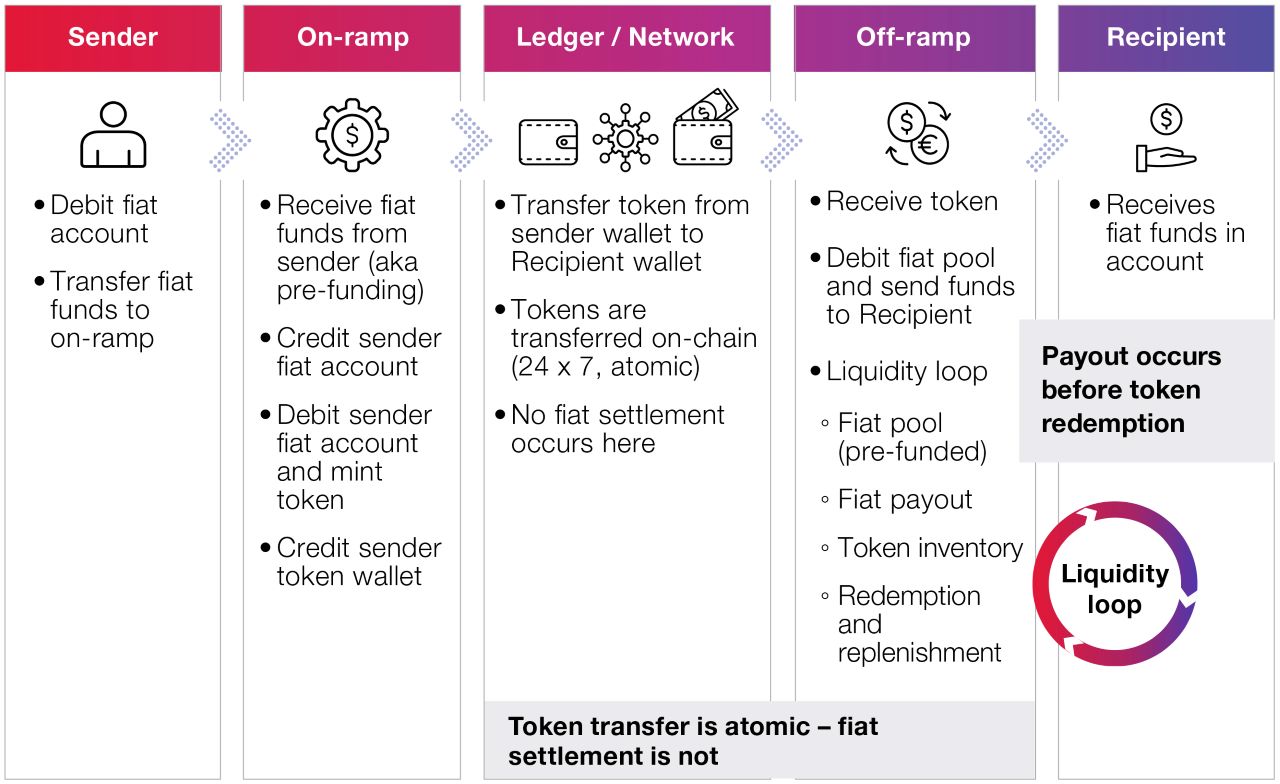
The most overlooked component of stablecoin-based payments is the off-ramp. While token transfers on blockchain networks are near-instant and atomic, the conversion back into fiat currency is neither. The off-ramp must fund the payout to the recipient in local currency, typically from pre-funded liquidity pools or credit facilities.
In practice, this means the off-ramp is extending liquidity ahead of settlement. Upon receiving the stablecoin, it holds a digital asset while having already disbursed fiat funds. This creates a temporary funding gap that must be managed through inventory, redemption, or offsetting flows.
This introduces a structural reality; stablecoin payments are not purely a messaging or settlement innovation, but a liquidity and treasury problem. The blockchain leg may be atomic, but the fiat leg remains dependent on balance sheet capacity, market liquidity, and funding costs.
As a result, stablecoin payment models resemble traditional correspondent banking and FX netting systems rather than a fundamentally new form of money movement.
Structural constraints on payments
Stablecoins are often positioned as a cure-all for payments friction. In practice, their benefits are context-dependent and come with trade-offs. Many of these constraints stem directly from the needs to manage off-ramp liquidity, funding and conversion between token and fiat systems.
On ramps and off ramps remain a bottleneck: Stablecoins must still be bought, redeemed, and priced. Each conversion introduces cost, spread, and operational dependency.
Forex (FX) friction does not disappear: It is deferred, not eliminated.
Cost structures are opaque: Trading fees, market spreads, wallet and storage costs, and execution premiums quickly erode theoretical efficiency gains.
Trust does not scale automatically: Mass adoption requires confidence in redemption, liquidity, governance, and legal certainty-areas where fragmentation undermines scale.
These constraints are manageable for banks and large corporates operating at scale, where liquidity, credit and treasury functions already exist. They are significantly more challenging in a retail payments context where simplicity, transparency and ubiquity are essential.
This dynamic is often obscured in simplified “stablecoin sandwich” diagrams, where token movement appears atomic, but the underlying fiat settlement and liquidity funding remain external to the blockchain.
Stablecoins – from payment rails to liquidity systems
 |
Why stablecoins are not well suited for retail payments today
Retail payments succeed when they are ubiquitous, invisible, cheap and trusted. Stablecoins in a retail context fail on all four dimensions… today.
Consumers have little tolerance for:
- Managing wallets and keys
- Price volatility
- Irreversible transactions
- Complex or opaque fee structures
This is the same reason that Bitcoin and other digital assets remain fringe payment instruments. The friction is simply too high, and the value proposition too weak, compared to cards, instant payments, and account to account transfer capabilities.
Where stablecoins do have an edge
Stablecoins do demonstrate value in specific, constrained contexts, particularly where traditional banking infrastructure is limited, fragmented, or inaccessible.
In these environments, stablecoins can provide an alternative mechanism for holding and transferring value outside of conventional financial systems. This can simplify certain types of cross-border transfers or reduce reliance on intermediaries in specific corridors.
However, these use cases are highly contextdependent and do not translate directly into mainstream payment adoption. Even in these scenarios, funds must ultimately be converted back into local currency to be useful for everyday transactions – which re-emphasizes the same offramp dependencies, liquidity requirements, and cost structures.
As a result, stablecoins are most effective in controlled or specialized environments, rather than as a general-purpose payment rail. These characteristics align more closely with treasury and settlement functions than with retail payments, suggesting that the most scalable evolution will occur within regulated financial systems, including tokenized deposits.
The coming arbitrage era: Lessons from high frequency trading
As more and more stablecoins emerge, markets will behave as markets always do: exploit differences! Even with stablecoins being “pegged 1:1”, there will be discrepancies and differences across multiple bank and corporately issued stablecoins appearing in the market.
We should expect sophisticated traders and other participants to arbitrage:
- Peg stability and deviations
- Redemption speed and certainty
- Issuer credit quality or creditworthiness
- Blockchain congestion and settlement latency
- Demand imbalances across closed networks
This dynamic is not new. It closely mirrors the high frequency trading exploits of the early 2000s, where micro differences in timing, pricing, and infrastructure became profit opportunities. Stablecoins will create similar seams and traders will find them.
The emergence of multiple stablecoins tied to the same fiat currency also fragments liquidity across issuers, networks, and redemption mechanisms. In practice, this creates parallel markets for what is nominally the same unit of value. Differences in trust, redemption speed, and market depth inevitably invite arbitrage and speculative trading activity rather than payment efficiency.
Implications for banks, corporations, and central banks
If privately issued stablecoins introduce fragmentation, credit exposure, and arbitrage dynamics, it raises a broader question: should the settlement layer itself remain anchored in sovereign money?
There is also a more interesting and more pragmatic path emerging at the sovereign and infrastructure layer, one that does not rely on privately issued stablecoins at all.
A compelling alternative is the use of currency coins issued by central banks, purpose-built for cross-border clearing and settlement between trusted monetary authorities. In a North American context, this could mean a Canadian dollar settlement token issued by the Bank of Canada and a U.S. dollar settlement token issued by the Federal Reserve, used exclusively for inter-central-bank and inter-system clearing and settlement.
A settlement layer anchored in central bank money also avoids the liquidity fragmentation that can emerge when multiple privately issued stablecoins compete to represent the same currency. Rather than attempting to create a single global rail, these currency coins could act as bridges between domestic real-time payment networks.
In practice, this could involve linking Canada’s real-time rail (RTR) with the FedNow infrastructure. Settlement between the schemes would occur at the central bank layer, in central bank money, while domestic realtime payment systems continue to serve end users as they do today. This approach would eliminate the need for Nostro / Vostro accounts at the commercial bank level and facilitate real-time settlement, which is one of the foundational features of real-time networks that is difficult to achieve in a cross-border context. Moving real-time payment messages is relatively straightforward, but real-time settlement remains far more complex due to currency conversion requirements and the need for liquidity or collateral to back the transactions.
This model preserves monetary sovereignty, avoids introducing new private credit risk, and leverages existing trust frameworks. It also focuses innovation where it delivers the most value: wholesale clearing, liquidity management, and cross-border settlement finality.
In this construct, tokenization is not about replacing money, it is about modernizing how central banks and payment systems interoperate across borders. For banks and corporates, stablecoins and tokenized deposits are best understood as infrastructure enhancements, not monetary revolutions. They offer meaningful gains in liquidity efficiency, operational resilience, and settlement speed, within controlled environments.
For central banks, the lesson is clear: innovation at the wholesale layer can deliver real benefits without displacing money, destabilizing trust, or introducing unnecessary consumer risk.
Closing perspective
Stablecoins are neither a threat nor a panacea. They are a specialized tool with specific, context-dependent value. Used correctly, they can solve specific, institutional problems. Used carelessly, they introduce new forms of risk, arbitrage, and fragmentation.
In practice, many of the benefits attributed to stablecoins may ultimately be delivered through tokenized deposits operating within regulated financial institutions.
The future of payments will not be won by tokens alone. It will be shaped by trust, governance, interoperability, and fundamental economics… just as it always has.
__________________________
Sources1,2 Stablecoins draw attention but are still a tiny market. | Payments Source | American Banker