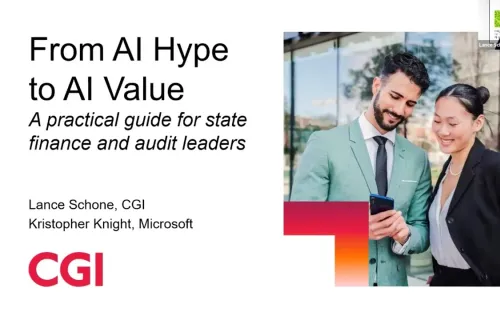
At this year’s National Association of State Auditors, Controllers and Treasurers (NASACT) Annual Conference, I had the privilege of joining two CGI clients on stage to explore how ERP modernization is transforming in this time of accelerated change. We shared best practices from state finance leaders on adopting emerging technology, overcoming resistance, and building digital ecosystems.
Let’s look at how our conversation evolved during the presentation.
The pace of change
Human innovation has always reshaped society. Consider the wheel—first crafted for pottery around 3500 BCE, later adapted for transport, and gradually refined for the vehicles we know today. That evolution spanned millennia. By contrast, in just the past 20 years, we’ve seen waves of disruptive technologies—generative AI, smartphones, electric vehicles, self-driving cars, and more.
The lesson is clear: the pace of change isn’t just speeding up, it’s exponentially accelerating. This acceleration touches every aspect of life—how we connect, travel, and work. Government operations are no exception. For ERP strategies to remain effective, they must evolve alongside regulations, emerging technologies, and industry trends.
The state of the market
In June 2025, CGI partnered with NASACT to survey challenges and opportunities in state government finance. The top three hurdles identified for ERP modernization were workforce shortages and hiring challenges, technical debt, and resistance to change. Let’s take a closer look at each.
Workforce challenges
Government workforce challenges are not new, but they are evolving. Over the past five years, COVID-19 marked a major inflection point. Recruiting surged as governments faced mass vacancies, and many agencies modernized hiring practices to compete with the private sector. While these efforts helped, recruiting alone is not a sustainable strategy when the pool of qualified candidates is limited.
Today, retention is just as critical as recruitment. The “silver tsunami” of retirements among the boomer generation is only halfway complete, and its impact will continue for the next decade. The good news is that agencies still have time to capture institutional knowledge and develop internal talent to fill senior roles that will be vacated. Balancing recruiting with succession planning, employee development, and other retention strategies offers a cost-effective way to manage this challenge.
Staffing ERP projects
Workforce trends are amplified in ERP modernization. Here are three tips to adequately staff your ERP project:
- Plan early: Work with your vendor partner and IV&V to establish realistic staffing strategies for both implementation and long-term support.
- Assess your workforce: Identify subject matter experts nearing retirement, anticipate FTE reallocations, and create a comprehensive staffing plan. A transparent look into your workforce will help you identify and address potential roadblocks well before project kickoff.
- Execute a balanced approach: Blend internal development with external hires. Embrace creative strategies to retain and recognize project staff to keep modernization efforts on track.
Technical debt
While there has been a significant shift toward modern, unified solutions over the past decade, homegrown solutions, disparate systems, and on-premise ERP solutions that have fallen behind release schedules add to ongoing technical debt.
Gartner® recently released the Hype Cycle for ERP, 2025. While there is plenty of interesting information in this report, what we found most valuable is the section on cloud ERP for the public sector. This isn’t necessarily a new topic; in Gartner language, it’s in the “slope of enlightenment,” but the drivers and obstacles outlined are powerful reminders. This research provides recommendations for successful transformation—from refining ERP modernization strategies in the context of composable enterprise data to addressing internal skills needed for cloud deployment.
Resistance to change
People often resist change because it threatens their sense of stability, identity, and control. However, the main drivers of resistance can vary; thus, the solution to overcoming resistance must also vary. One solution is to focus on transparent communication.
By sharing the benefits of transformation early and often, leaders can ease fears rooted in the unknown, anticipated effort, or past negative experiences. Clear, consistent communication from trusted leaders at every level—and in multiple formats—helps ensure messages resonate across the workforce.
Market uncertainty
CGI’s Voice of Our Clients research shows that 69% of leaders cite political, fiscal, and regulatory change as the top driver for finding smarter ways of working.
With rapid regulatory shifts, funding uncertainties, and legislative changes, public sector organizations are navigating an unprecedented market.
AI’s impact on modernization
No discussion of modernization is complete without AI. In 2020, AI in government was emerging—used for chatbots and robotic process automation, among other basic tools. By 2022, ChatGPT brought generative AI into the mainstream. Today, most states have either passed or are actively working on AI legislation, and AI adoption continues to accelerate across the country.
As we look ahead to 2030, AI will only deepen its role in government. It offers vast opportunities but also brings new challenges. Modernization in the age of AI is about balance—leveraging human judgment and institutional knowledge alongside the power of advanced technology.
Achieving successful government transformation
Transformation in government is not about moving fast and breaking things; it is about building a solid foundation for future generations. When modernization is done right, it builds trust, strengthens transparency, improves efficiency, and creates lasting impact.
Here are three foundational practices for driving transformation in today’s environment:
- Build a strong foundation: A solution built from the ground up for government and flexible enough to grow with you as regulations shift and expectations change is a critical element of transformation that reduces overall cost, risk, and complexity—during the initial project and beyond.
- Surround yourself with experts: Delivering transformation on time, on scope, and on budget requires trusted partners with deep industry expertise and a mindset anchored in long-term partnership. Subject matter experts who understand government operations can help shape a strong modernization strategy, guide execution, and ensure continuous improvement well beyond go-live.
- Take an honest look: A deep dive into your organization is essential to uncover vulnerabilities and focus areas for modernization. Whether it’s capturing institutional knowledge as senior staff retire or establishing clear regulations for AI and other emerging technologies, an honest assessment of your current state lays the groundwork for lasting success.
Partner with CGI
For almost 50 years, CGI has consistently delivered seasoned government transformation professionals and built-for-government software that drives successful transformation for state and local governments from coast to coast. Learn more about CGI Advantage and connect with an expert today.
About this author

Elissa Goad
Director, Consulting Expert | U.S. IP Solutions
Elissa brings more than ten years of experience supporting state, local, and federal government modernization. She has in-depth expertise in translating established and emerging technology into real-world benefits and aligning organizations with solutions that drive their business outcomes now and in the future. Since joining ...