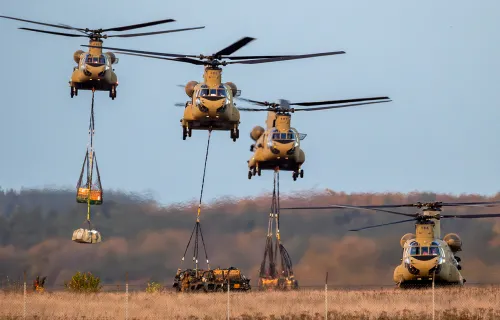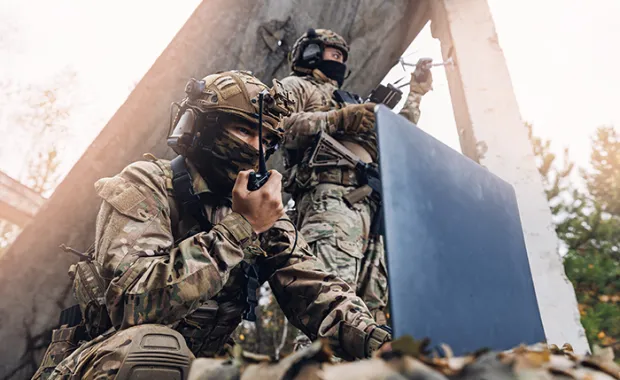
Modern warfare is a constantly evolving landscape where alliances shift, strategies adapt and technology advances, often rapidly. The U.S. military prides itself on being prepared for the next conflict, prioritizing modernization, readiness, adaptability and global presence.
In the fast-moving landscape of global defense, maintaining military readiness is not just a goal – it’s a necessity. Military forces must continuously innovate, integrate and harmonize technology across all branches. Falling behind is not an option.
Coordinating fire support systems
Military branches do not operate in isolation from one another. The Department of Defense’s Combined Joint All-Domain Command and Control (CJADC2) strategy requires integration across all warfighting domains, from all of the branches of the military, to include our international partners.
Aligned with that vision, the Army is spearheading the modernization and expansion of systems that coordinate and employ traditional, non-traditional, long-range, surface-to-surface and surface-to-air weapons platforms, collectively known as “fires.” The modernization initiative is creating the next generation of fires, incorporating a new command and control (C2) gateway. This will enable continuous modernization and updates, ensuring interoperability between legacy and emerging systems to evolve to meet future mission requirements.
Coordinated fires, both offensive and defensive, enable communication beyond line of sight, integrating long-range weapons systems and interfacing with CJADC2 systems, to achieve operational success, contributing to convergence.
Rapid data sharing and informed decision-making are crucial for success in fast-evolving conflicts. Expanding communications modes to include 4G and 5G waveforms—and moving away from easily detected radio signals—is a piece of this transformation, enabling data sharing while protecting the personnel transmitting and consuming the information.
Building on a 40-year legacy: CGI Federal’s continued support for integrated fires and data management
CGI has been an unwavering force in advancing military fires operations since the 1980s, demonstrating our commitment to enhancing defense capabilities. Since 1995, the U.S. Army has relied on the Advanced Field Artillery Technical Data System (AFATDS) to coordinate fire operations. This legacy system has been instrumental in providing automated support for planning, coordinating, and conducting fires. However, the military is ready to move to a next-generation C2 system, incorporating an array of advancements such as multiple advanced communications modes.
CGI is an expert in field artillery command and control systems and served as a key partner in the development and evolution of AFATDS since its inception. Our support for over 30 years has ensured the system’s effectiveness through ongoing updates and enhancements. As the Army transitions to a joint C2 Gateway, CGI is committed to the transformation, making data sharing simpler and effective, leveraging our expertise to enable a seamless, responsive, and multi-domain fires ecosystem.
Conclusion
All of these capabilities, combined with the unique needs of transmitting data in remote, rugged terrain, call for industry partners with extensive experience and deep domain knowledge. Learn more about how CGI Federal can assist in military modernization.
About this author

Al Fraser
Vice President
Al Fraser is Vice-President of the Huntsville/Lawton Metro Operations within the Army Sector at CGI Federal. He leads all activities for the Army and Other Defense Agencies, providing front-to-back oversight for business development, project delivery and closeout.