
Organizations continuously modernize, but are they modernizing for today or for the future? When faced with the pressure to keep architecture relevant, CTOs must find a way to push modernization efforts forward without creating work that has to be redone.
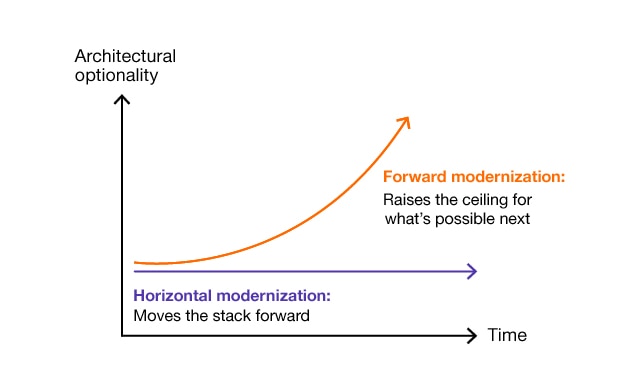
CTOs must separate horizontal and forward modernization decisions and include forward modernization in their architecture roadmap. Leaving it out increases the cost of future change and slows the organization’s ability to respond. The question isn’t whether to plan for the future; all good CTOs already know that. The real question is how to start modernizing for the future without rewriting the entire architecture.
Horizontal modernization
When organizations refer to modernization, they most often mean horizontal modernization. Horizontal modernization focuses on moving legacy software and systems to newer technologies, layer by layer.
Common examples include rewriting an older UI built on a dated framework into a modern React-based UI, breaking a monolithic service into microservices, or using a strangulation approach to migrate functionality to newer platforms while gradually retiring legacy services.
Forward modernization
The term “forward modernization” has its roots in public-sector and infrastructure contexts, but I’m using it here to describe a similar mindset in enterprise architecture. We see this concept in federal modernization programs and financial regulation—updating not just for today’s gaps, but for tomorrow’s demands. The same thinking applies to enterprise systems. Forward modernization describes an approach that not only upgrades technology but also prepares the architecture to absorb what’s coming next.
The intent behind forward modernization isn’t rewriting an entire application or meeting a future need today. It’s about incrementally introducing architectural change in preparation for what comes next.
Let’s use “horizontal modernization” as an example: rewriting a front-end using a modern framework. What if you know you’ll eventually need to support mobile applications? Don’t just pick any framework—choose one with mobile support. When defining the reference architecture for mobile, it's easy to see which decisions you make now will smooth that transition later.
The risk isn’t the framework. The risk is optimizing for one channel without designing for multi-channel evolution.
Forward modernization
Anchor in value
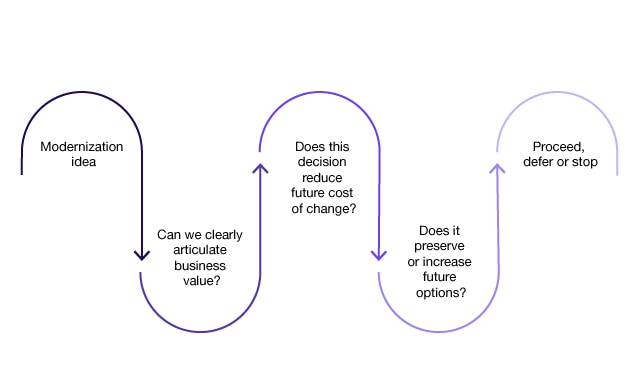
CTOs must guard against platform ambition untethered from outcomes. When making modernization decisions, if you can’t articulate business value, it is not a modernization priority.
Engineering elegance disconnected from value leads to horizontal modernizations that don’t move the needle—and often fail or require rework.
When deciding what to modernize, apply a business-value lens. Rigorously applying this lens to architectural decisions naturally shifts modernization efforts into value-driven propositions.
If you’re planning a horizontal modernization, look for opportunities to tie in future business direction to increase its value. For example, if the roadmap already includes modernizing an API framework and the business is moving toward AI, selecting a framework that also supports Model Context Protocols (MCPs) can be a high-value, low-regret choice. In this case, incorporating MCPs anchors forward modernization directly in business value.
Anchor in value
Change how decisions are made
Most modernization programs stop at “new stack.” What if the real risk isn’t legacy technology, but legacy thinking? CTOs must incorporate forward modernization and anchor business value directly into roadmap decisions. Without this discipline, organizations default to chasing trends—and repeatedly rewriting architecture.
About this author

Laura Elmufdi
Director, Consulting Services
With more than 25 years of experience delivering enterprise technology solutions, Laura Elmufdi specializes in modernizing complex platforms and aligning architecture to measurable business outcomes.