
Paper cards, predictive dialers, digital channels, agentic AI — collections has come a long way in less than 50 years. In the mid-1980s, paper cards and pens, not computers, were still standard practice for managing debt collections. That may seem almost unimaginable to many collections professionals today. But around that same time, companies like CGI began enabling a significant shift from paper cards to computerized collections software for tracking past-due customers and collections efforts.
This key enhancement, along with the introduction of automated, predictive dialing, set in motion decades of continuous evolution in collections. Over the past decade, that evolution has increased to a pace that many institutions struggle to keep up with.
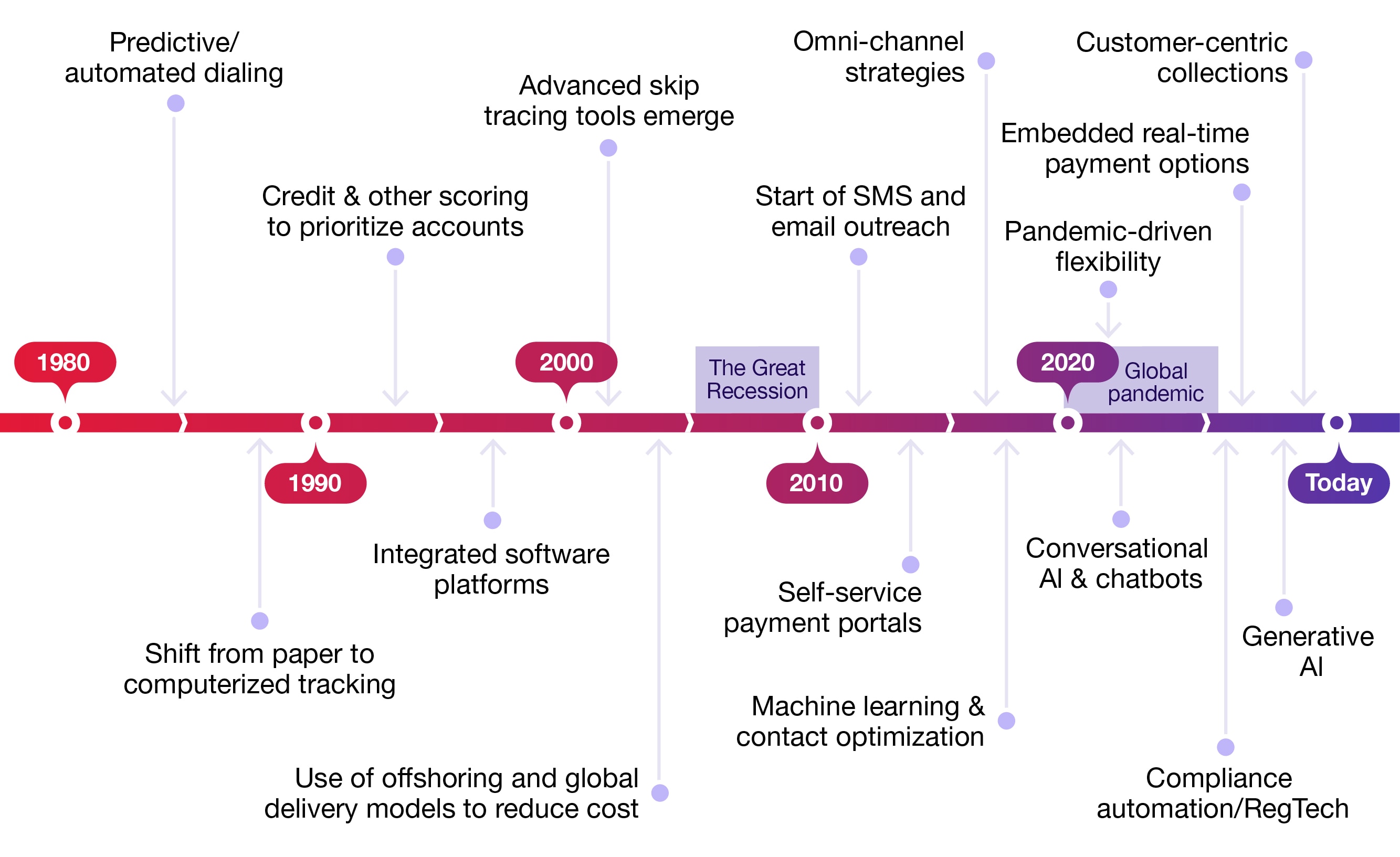
Collection evolution timeline
New collections trends are constant, as illustrated in the graphic above. Some are in their early stages, while others are more mature. Some come on the scene and change the face of the industry; others show up, provide a short-term lift and then fizzle out.
The six buzz-worthy signals highlighted in this blog are among the debt management trends we’re hearing about in the industry today. Some of these collections trends will reshape the industry, some won't. Here's our take on whether or not they are here to stay.
Digital first, human-when-it-matters
What it means: Collections has traditionally operated with phone and physical letters as the default channels for outreach. Today, the default channel is transitioning to digital. According to CGI’s 2026 Voice of Our Clients (VOC) research, 61.5% of retail banking respondents cited digital transformation, channels and customer experience as an impactful industry trend, confirming that digital engagement is no longer optional for customer-facing functions such as collections. However, this doesn’t mean humans are now “out of the loop”. Human support should always be a click or request away, and smart escalation protocols should automatically route sensitive cases to a human agent.
Main benefit: Basic collections use cases can be handled through self-service portals, chatbots and AI-powered collectors, while human attention is focused where it matters most.
Most likely obstacle: Poorly connected channels can create customer frustration, duplicate outreach, consent issues or difficulty routing to a human agent.
Our take: Going digital requires careful consideration before being put into action. An ecosystem that supports the transition must be established, including web portals, chatbots, AI vendors and related services. Clear direction and buy-in from compliance should also be sought before deciding which processes default to digital vs. human handling. Another important consideration is understanding how to detect when a customer needs human empathy in a collections interaction to avoid sending them through a channel that might seem robotic. Digital engagement is generally baseline functionality in modern collections solutions, enabling direct outreach with customers.
Verdict: Emerging and here to stay
Agentic AI in collections
What it means: Agentic AI enables collections platforms to plan, reason and take action autonomously within defined guardrails. Other than assistive AI, AI collections agents may proactively engage customers through channels such as chat or SMS, or complete multi-step tasks.
Main benefit: Expands capacity by automating routine collections activities, allowing specialists to focus on higher-value interactions.
Most likely obstacle: Governance, oversight and trust. Organizations need clear guardrails, accountability and human oversight before deploying autonomous AI at scale.
Our take: Agentic AI represents a significant evolution in enterprise AI, but organizations are still in the early stages of adoption. While the technology has the potential to automate complex workflows and improve productivity, scaling it requires mature governance, security, integration and human oversight. In our 2026 VOC data, only 1.6% of banking respondents report agentic AI implementation as complete and in continuous improvement, while 75.8% are still investigating or at the proof-of-concept stage; the remainder are either implementing it now or say it is not for them. As collections platforms evolve, we expect agentic AI to become increasingly embedded into debt management workflows within well-defined guardrails.
Verdict: Early stages and inevitable
Invisible collections
What it means: Collections is typically considered an event. But what if it were built into the entire customer experience, so that it was undetectable to the customer? Collections would still be needed, but with far less customer traffic. Small additions throughout the customer experience would be needed, for example, a proactive prompt in the mobile banking app before a payment is missed, easy-to-resolve delinquency with a maximum of 1 or 2 clicks, or proactive hardship offers based on account and/or customer relationship behavior. This shift aligns with our 2026 VOC data, in which 34.0% of retail banking respondents cited customer experience and service quality as a top business priority, reinforcing the need for collections experiences that feel less like isolated recovery events and more like seamless extensions of the customer relationship. The goal is to guide the customer to resolve their debts with minimal intervention from collections.
Main benefit: Making customers aware of potential delinquency and making it easier for them to self-cure reduces customer traffic in collections.
Most likely obstacle: Over-automation could result in unintended consequences, such as populations of accounts becoming stale or unconscious bias.
Our take: It’s only a matter of time before invisible collections become more prevalent in the industry. When done properly, it is truly invisible to the customer, and customers don’t realize that some of the actions they take are collections-driven. Most modern debt management solutions have several components that can propel this trend forward, such as easy-to-use self-service portals, smart strategy engines that score and segment accounts and robust loss mitigation workflows.
Verdict: Early stages and inevitable
Alternative data and signals
What it means: Traditionally, static data points have been used to evaluate accounts and assign risk attributes, for instance, credit scores or payment history. When access is available, expanding this data set to include points such as deposit trends, demand deposit account (DDA) balances and transactions, or employment history enables institutions to recognize patterns and apply proactive treatment to accounts to help prevent severe delinquency.
Main benefit: Access to leading indicators to preempt delinquency.
Most likely obstacle: Lack of key data across the entire portfolio, potentially resulting in disparate treatment if applied only partially.
Our take: In theory, this is an amazing concept; however, in practice, it is very difficult to achieve. The days of customers having all of their loan, credit card and deposit relationships with one institution are all but over. The lack of this key data makes this concept nearly impossible to fully achieve, unless operating in an open banking environment. While this may be possible for a limited subset of customers, applying this logic and treatment only to a select subset could result in disparate treatment.
Verdict: In the U.S., early stages and non-starter; in the EU, established and steady
Smart automation
What it means: Automation within a software suite generally means rules-based activities that are initiated automatically. Smart automation is a completely adaptive, self-improving system that includes self-learning workflows, perpetual A/B testing of strategies and autonomous collections with human oversight.
Main benefit: With a self-learning system, debt management strategies are constantly refined in real time so they are always optimized, such as the best time to call, the next best action and the best channel.
Most likely obstacle: Overall governance could be difficult.
Our take: Automation within collections systems is almost on an evolution trajectory of its own, and that trajectory is up. Over the coming years, automation will become more robust, and embedded strategy engines will be asked to do more, likely by leveraging AI and ML collections models, to achieve the business goals. Most modern collections solutions can accommodate this trend now, to a certain extent. However, keeping up will require ongoing diligence and innovation.
Verdict: Emerging and here to stay
Ethical and regulatory evolution
What it means: Compliance typically serves as a constraint on collections, but it is shifting toward being a design principle. Regulators are paying closer attention not just to what is done but to how decisions are made, especially with AI, and demanding that strategies and decisions be explainable.
Main benefit: Traceability that always shows why a decision was made.
Most likely obstacle: Risk of unconscious bias still exists.
Our take: Regulations will always be a critical consideration in collections. Data from the 2026 VOC reinforces the pressure: 64.3% of banking respondents cited regulatory pressure, compliance and governance as an impactful industry trend. As AI is woven into collections processes, those processes will receive even more scrutiny from regulators. Institutions are taking this as an opportunity to expand compliance, so it is not just documented on paper and monitored through quality control practices, but fully embedded in their modern collections software.
Verdict: Established and accelerating
As debt management trends continue to move toward more digital, intelligent, adaptive and governed operations, institutions need collections technology that can support both innovation and control.
Explore how CGI Credit Studio for collections supports modern debt management through digital engagement, intelligent automation, embedded decisioning and compliance built into daily operations.
About these authors

Andrew Hopkins
Director, Consulting Expert
With more than 20 years of experience in financial services and consulting, Andrew brings deep expertise in credit and collections transformation. He has supported a wide range of modernization initiatives across the U. S. , UK and Asia-Pacific, with a focus on digital workflows, compliance ...

Adam Chandler
Director, Consulting Expert
Adam works with our institutional clients to address their technology needs throughout the credit life cycle. He has more than 20 years of experience in banking and technology, with deep expertise in default management and contact center optimization.