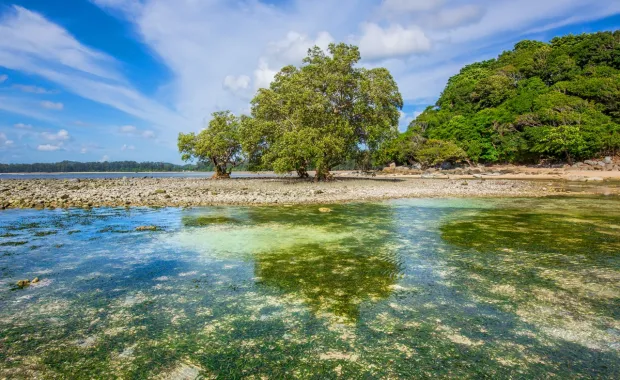
Wetlands, rivers, lakes and peatlands are some of the planet’s most important ecosystems. They store carbon, support wildlife and reduce flood risks.
From rivers in the UK to lakes in India and wetlands in Germany, CGI is helping to restore and protect aquatic ecosystems—vital sources of biodiversity and resilience in the face of climate change.
Large-scale environmental restoration requires collective expertise and commitment. By combining human effort, science and advanced technology, we contribute to projects that deliver direct benefits for communities and the environment.
UK: Restoring rivers and protecting coastal habitats
Through our Sustainability Exploration and Environmental Data Science (SEEDS) program, we partnered with the South East Rivers Trust to tackle Himalayan Balsam, an invasive species that causes significant harm to river ecosystems. Using artificial intelligence and data from 55 volunteers, we are mapping its spread across three drainage basins to support early, targeted intervention, protect habitats and strengthen biodiversity in the UK. As part of this work, effective eradication requires the physical removal of plants before they go to seed or consistent, focused herbicide application.
CGI in the UK also maintains a longstanding relationship with the global marine conservation charity, Project Seagrass. As part of this partnership, CGI Partners participated in a seagrass survey and beach litter pick to help conserve seagrass and support the local environment and biodiversity.
Working with businesses and landholders since 2006, we have helped fund the planting of over 13 million trees and the restoration of 2,000 hectares of degraded peatlands. These projects will remove 3.3 million tons of CO2e* emissions from the atmosphere and contribute to flood regulation, biodiversity and public access.
India: Reviving lake ecosystems through community partnerships
In Bangalore, India, we partnered with environmental NGO, That’s Eco Foundation, and residents of the Kasturi Welfare Association (KWA) to revive the long-neglected B. Channasandra Lake. For more than three decades, the 19-acre lake had been buried under debris and overgrowth. Its restoration began when local residents uncovered its history and launched a community-led movement, contributing funds and volunteering time to reclaim the land. To support the scale of work, That’s Eco Foundation developed a long-term ecological plan, and CGI joined as a ESG partner to fund key scientific restoration activities and ensure long-term maintenance.
Together, CGI, the NGO and the community carried out essential interventions such as desilting the lakebed, reinforcing bunds, restoring natural water inlets and outlets, and creating native islands to improve biodiversity. These efforts have significantly increased groundwater recharge and restored the lake’s capacity to hold up to 200-280 million litres of rainwater, helping ease local water stress.
What was once a barren land is now a thriving urban ecosystem with more than 32 native islands that attract birds, butterflies and other wildlife and provide the community with a peaceful, green space.
CGI in India continues to support biodiversity expansion through plans for a mini forest, butterfly garden, solar-lit pathways and a community-driven biodiversity park, making this project a model for urban ecological revival.
Germany: Conserving wildlife and renaturing local waterways
In Erfurt, Germany, CGI Partners and their children helped The Nature And Biodiversity Conservation Union (NABU) e. V. monitor an amphibian protection fence in the districts of Hochstedt and Windischholzhausen. Participants learned how these structures help frogs, toads and newts safely migrate during spawning season by using protective netting and collection containers to keep them away from roads.
Near-natural streams significantly contribute to biodiversity by securing habitats for native animals and plants, improving water quality and strengthening local ecosystems. In Hamburg-Wandsbek, we completed the first phase of a major conservation project with a nonprofit to renature the Rahlau creek. CGI Partners removed artificial barriers to create shallow bank zones and new habitats for amphibians, fish and insects. This hands-on effort was a valuable experience for our team and demonstrated how practical measures support broader sustainability goals.
Across regions, these partnerships demonstrate how community support and technology can help restore ecosystems and strengthen climate resilience.
*carbon dioxide equivalent