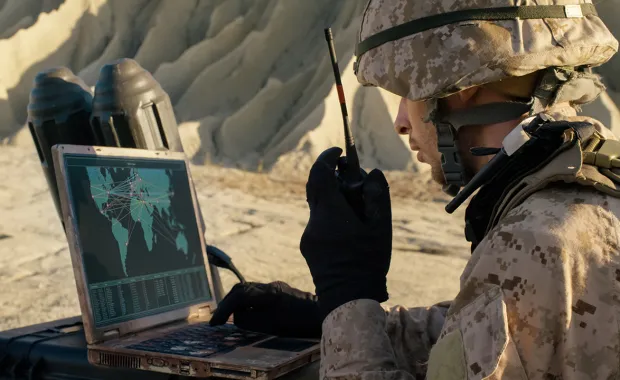
Military operations depend on logistics, which means supply chains, warehouses, materiel and logistics support systems are all ripe targets for attack.
The Defense Logistics Agency is on the front lines of this particular battle, and its leaders understand that adversaries intend to attack the logistics advantages that let the joint force project power anywhere—and increasingly, they have the means to do just that.
DLA's answer is decision advantage: seeing the enterprise clearly enough to act faster than an adversary. The agency is building a unified, AI-powered digital backbone for end-to-end supply chain visibility and predictive analytics.
At the recent DLA Industry Collider Day, leaders from the government and industry met to unpack the current state of contested logistics and how industry and agencies must collaborate to defend the nation. Total asset visibility has become a readiness requirement.
Speed matters—if the data is right
A core problem is data debt, when the same transaction carries different values in different systems. This means the official records are not necessarily accurate reflections of the location and status of assets.
The agency is building a single source of truth with defined authoritative sources, where automation handles routine transactions and exceptions go to a person for a decision. To get the most value from the system, logistics systems must move to API-enabled data exchange, which enables AI to analyze and update data rapidly. As DLA Program Executive Officer James Johnson summarized at the event, "speed wins."
Moving records more quickly is useful only if the data is good.
Moving bad records faster just accelerates the spread of error.
However, the information must be accurate. It must be communicated across DLA’s tech stack, and it must be actionable.
Speed and accuracy cannot be separated. Moving records more quickly is useful only if the data is good. Moving bad records faster just accelerates the spread of error. In a fight, the record is what commanders fall back on when feeds go dark, and it has to hold.
Testing the record
Leaders don't need a wall-to-wall inventory to find out whether their records can be trusted. A few targeted checks will show it.
- Run a blind sample count. Pick a random set of locations and have teams count them without seeing the system quantity. Score accuracy by location and by item category, and give extra weight to sensitive and high-value items. The gap between what the system says and what the team counts is your baseline.
- Count in both directions. Floor-to-book counts find items the system doesn't know about. Book-to-floor counts find phantom inventory that exists only on paper. At DLA Distribution Anniston, a physical inventory reconciliation resolved a 450-item discrepancy, and restored full asset accountability.
- Check the age of discrepancies and adjustments. Look at how many inventory adjustments are open, how much they're worth and how old they are. Ask how many were closed without research into the cause. A growing backlog means the record is drifting.
- Trace transactions from end to end. Follow a sample of receipts, issues and moves from the physical event to the system post. Measure the lag and look for ghost work in progress: material that has left the building but still shows on hand because a handheld lost connection. At Anniston, receipt processing time dropped significantly once this became a discipline.
- Compare the same items across systems. Pick a set of critical national stock numbers and compare quantity, location and condition across the warehouse, property and financial systems. Wherever they disagree, the organization has to decide which record is authoritative.
Preparing for the contested logistics fight
Leaders should:
- Name the authoritative source for every critical data element and write down the rule for settling disagreements between systems.
- Count continuously. Start with sensitive and mission-critical items, so the record never goes more than a few days without being checked.
- Rehearse working without the network. Cut the data feed in an exercise and see whether units can operate from the last reconciled record. Determine the record’s age and identify the manual fallback.
- Choose sensors for the environment they'll work in. What works inside a secure depot may give away a position forward in a theater.
- Automate the routine, with experienced personnel making the judgment calls. Let systems post what they observe, but keep a named person accountable for adjustments to the record.
The record has to hold
CGI's Automated Inventory Management (AIM) [MH2.1]capability counts inventory continuously using autonomous drones, passive radio frequency identification (RFID), and active tracking for sensitive items. It reconciles that count against the accountable property record, with personnel adjudicating each discrepancy before the correction closes in the system of record.
That design matters in contested conditions. A visibility system built only on sensing degrades toward confident error when the network is disrupted. A system built on a reconciled, accountable record degrades toward a number a commander can defend.
The sensor mix matters too: passive tags stay silent until read at close range, while active emitters that work well inside a secure depot can become beacons in a theater where an adversary is hunting signals.
The results hold up at scale. DLA R&D piloted AIM at DLA Distribution Anniston beginning in 2024, where continuous counting made reconciliation a standing practice instead of an annual event. The facility significantly reduced the number of person-hours needed to complete an extensive inventory through the AIM pilot. It showed that continuous inventory can save the agency billions of dollars and significantly improve decision-making.
Industry Collider Day made the case that contested logistics will be decided as much by the integrity of the data as by the strength of the supply line. DLA asked the industry to help solve that problem. CGI Federal is ready to help build the reconciled record that keeps the joint force supplied under pressure.
To learn more about AIM and total asset visibility, email me at brandon.ebel@cgifederal.com. We look forward to continuing these conversations with DLA leaders, including at the DLA Supply Chain Alliance Symposium and Exhibition, May 5-7, 2027, in Richmond, Virginia.
About this author

Brandon S. Ebel
Director of Business Development, Army & ODA Sector
Brandon Ebel serves as a Director of Business Development in the Army and Other Defense Agencies Sector at CGI Federal. In this capacity, he supports strategic growth, client engagement and mission delivery initiatives across defense and federal markets. Brandon joined CGI Federal with more ...