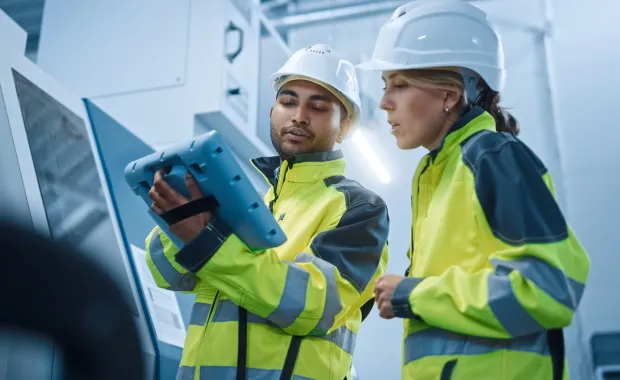
For years, manufacturers have sought to unlock the power of data. But the tools weren’t ready. Information sat in silos, compute power was expensive, and operational technology (OT) systems struggled to connect with IT. Plants collected oceans of data, but lacked the means to turn them into insights.
That is changing fast. The convergence of lightning-fast networks, smart IIoT devices, and Edge AI has opened a new chapter in data-driven manufacturing. Today, manufacturers can capture machine data from every line, analyze it instantly, and enrich it with context from ERP or supply chain systems.
What once felt futuristic is now a practical business decision. The question is no longer can manufacturers do this—it’s how fast do they want to scale?
Building on the past to shape the future
Most plants run on a blend of technologies—some decades old, others brand new. Replacing everything isn’t realistic or necessary. The power of augmented industrial data is its ability to build on what already exists. Lightweight connectors, edge analytics and APIs can capture and standardize data from old and new systems without disrupting production. Once contextualized with ERP, MES and supply chain platforms, isolated data points become meaningful insights. They can reveal why a line is slowing, when a part might fail, or how energy usage is trending across shifts.
Clarifying value to go from pilots to production
Many manufacturers have tested predictive maintenance. But the real transformation begins when pilots move into full production. This is where results become real.
In process industries, augmented industrial data detects anomalies in chemical blending, optimizes refinery energy loads, and tracks emissions in real time. In discrete manufacturing, it improves assembly quality, shortens cycle times, and even predicts spare parts needs before they cause supply chain bottlenecks.
Returns are measured differently depending on who you ask. Plant managers look at uptime, throughput, fewer manual interventions, and maintenance costs. Executives focus on margins, sustainability outcomes, and even new business models like product-as-a-service.
That’s why return on investment (ROI) must be central to every conversation. Without a clear and shared understanding of value—from smoother operations to measurable financial and ESG results—even the most promising pilots risk stalling at the proof-of-concept stage. Demonstrating and communicating returns, early and consistently, turns experimentation into transformation.
Trust: The foundation of scale
The real power of augmented industrial data isn’t volume; it’s trust. Scaling requires robust governance that protects data quality, lineage and security across IT and OT. Without that, analytics can mislead and erode confidence.
Trust also depends on transparency. Operators must understand why an AI model predicts a failure—not just that it does. Explainability builds trust and the understanding that AI will augment human expertise, rather than replace it.
Across the industry, AI is already amplifying human judgment. Predictive models extend asset life and reduce unplanned downtime. Generative AI automates root-cause analysis and provides guided troubleshooting. Optimization models balance production schedules, energy use, and resource allocation. Each one strengthens human decision-making and operational resilience.
To scale augmented industrial data initiatives successfully, manufacturers need both robust governance and explainable AI. Together, they create the confidence to act on insights.
From the plant to the ecosystem
The next evolution for augmented industrial data will extend beyond single plants. Initiatives like Manufacturing-X in Europe are paving the way for federated data spaces, where OEMs, suppliers and logistics providers share insights securely.
Success depends on three principles:
- Interoperability through common standards to connect systems across companies
- Digital sovereignty so each participant maintains control of their data
- Mutual value that benefits every player in the ecosystem—not just the biggest ones
When these conditions are met, the results are powerful. Shared visibility that strengthens supply chain resilience, accurate sustainability reporting (Scopes 1-3 emissions) across all tiers, and predictive collaboration between suppliers and OEMs to prevent failures together.
Overcoming the “proof-of-concept trap”
Augmented industrial data is not a buzzword. It’s a reality in leading plants worldwide. Manufacturers are enriching real-time sensor data with historical, contextual and metadata layers in real production environments today.
However, too many organizations remain trapped in perpetual pilots. Technology isn’t the barrier to scale; governance, culture and clarity of value are. Operators hesitate if AI feels opaque. Managers hesitate if the value is unclear. Executives hesitate if ROI seems vague or distant.
Scaling is a discipline. It demands governance frameworks that guarantee data quality and security across IT and OT. It requires a clear ROI that resonates with both the shopfloor and the boardroom. And it must be supported by leadership that views it as a catalyst to competitiveness, sustainability and resilience.
Success and challenges: Two sides of progress
Where augmented industrial data is deployed effectively, impact follows. Root-cause analysis that once took days now takes minutes because anomalies can be linked instantly to logs, operator notes and supply chain events. Operators no longer chase information; the insights come to them. Equipment reliability improves as data connects asset health with production KPIs and environmental conditions, enabling truly predictive maintenance.
But challenges remain. Integration across diverse OT environments remains difficult, especially with fragmented data models and proprietary vendor systems. Data governance requires new processes, roles and cultural changes. Cultural adoption takes time. And greater connectivity inevitably introduces new cybersecurity demands.
However, every friction point, when overcome, creates new competitive advantages. Manufacturers who address both the progress and the pain points head-on will be the ones that move the fastest—and furthest.
Looking forward
Augmented industrial data marks a defining shift in manufacturing—from isolated pilots to enterprise-wide adoption, and soon, cross-ecosystem collaboration. The future will belong to those who can predict, prevent and optimize. The technology is ready. The opportunity is real. The question is: how ready are we to use it?
Curious about what it takes to move from pilot to scale? Let’s connect to explore practical steps that turn your augmented data into measurable outcomes.
About this author

Helena Jochberger
Vice-President, Global Lead, Manufacturing and Consulting
As the Global Lead for Manufacturing & Consulting at CGI, Helena shapes the strategic direction of CGI’s global manufacturing portfolio and leads the evolution of our consulting services across industries.