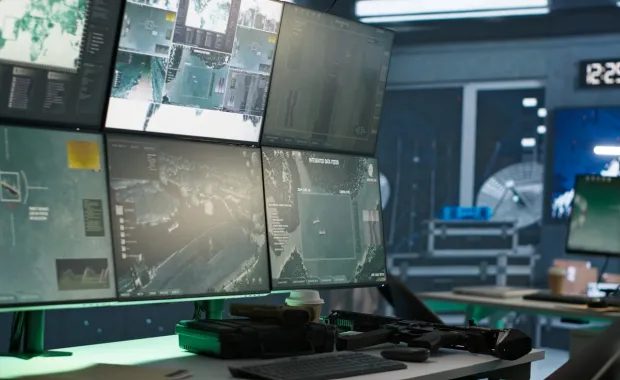
Federal agencies now operate in highly-interconnected, data-rich environments, where modernization, sustainment, financial execution, cybersecurity, workforce pressures and enterprise reporting no longer occur separately; they converge in the front office.
While this consolidation of diverse disciplines into one central organization can boost efficiency, it also presents a significant challenge: mission synchronization across fragmented operational ecosystems.
Operational complexity overwhelms coordination models
Front offices across federal organizations face growing operational and governance demands that increasingly exceed the abilities of traditional coordination models. Leaders must bridge reporting environments, connect siloed financial and operational data, modernization dependencies, and facilitate cross-functional decision cycles, while at the same time supporting near real-time visibility for senior executives.
These pressures affect modernization programs, readiness, sustainment operations, audit requirements and enterprise governance cycles. While none of these challenges are new on their own, their accumulation and interdependence pose a heightened level of difficulty.
Today’s operational rhythm demands that front office teams support leadership decisions that bridge mission execution, financial stewardship, modernization activity and enterprise risk. That coordination burden has become a structural inhibitor inside many agencies.
What modernized coordination looks like in practice
Most federal front office constructs were built for a fundamentally different operating environment defined by predictable workflows, periodic reporting rhythms and clear administrative boundaries. They are geared for document management and coordinating meetings, not the operational synchronization that agencies need today.
Modern environments demand enterprise visibility across mission, financial, cyber and modernization data with integrated workflows that reduce duplication and rework. Decision support must provide mechanisms for synthesizing information, not just routing it. Data-informed coordination is required to pull stakeholders into alignment.
This is not an incremental change; it is a strategic transition in how federal organizations operate at the enterprise level.
To meet these emerging shifts, agencies are now reevaluating the front office as an operational integration layer rather than a simple administrative node. As is always the case, reengineering processes to meet the demands of modern mission execution is a required aspect of a successful modernization effort.
Getting started is often the most difficult step for a modernization project, especially one as complex and mission critical as this. Consider these as opening steps:
- Identify the highest-friction coordination points. Front offices must understand where information flows break down and why decision cycles lag. This creates a practical baseline to define priorities.
- Define the common mission picture leaders actually need. Before building new tools or workflows, clarify the core information leaders rely on to make faster decisions across operations. The goal is to create a shared operating view that connects decision points.
- Standardize one or two high-value workflows. Early standardization on even a small set of front-office processes will reduce rework and builds momentum.
- Demonstrate the value of integrated visibility. Pilot an integrated coordination dashboard or decision support view can prove the power of modern coordination far more effectively than theoretical arguments.
- Establish governance for sustaining the coordination model. Assign clear ownership. Modernized mission coordination will only hold if it becomes part of the operating rhythm, not a one-time technology effort.
The enterprise advantage of a modernized front office
Integrated visibility across mission, financial, cyber, modernization and operational environments enables leadership teams to make decisions from a common enterprise picture rather than fragmented reporting streams. Standardized workflows reduce duplication and manual coordination, while automation and analytics accelerate decision cycles and improve organizational responsiveness.
The impact of this shift extends well beyond executing daily operation. It reshapes how the enterprise functions.
Financial management and comptroller organizations benefit from improved execution visibility and stronger governance alignment.
Program and modernization offices gain better coordination across technical dependencies and transformation initiatives.
Operations, logistics and cybersecurity leaders gain faster access to enterprise support, lending the way to expedited mission execution.
When done correctly, front-office modernization unlocks mission decision advantage through capabilities such as:
- Integrated operational dashboards that unify mission, financial, and readiness information
- Workflow automation that standardizes processes and reduces manual coordination
- AI-assisted information synthesis that distills large volumes of reporting into decision-ready insights
- Enterprise collaboration environments with role-based access and secure data sharing
None of these capabilities replaces the front office. They elevate it from a coordination center to an enterprise enabler.
Unlocking mission decision advantage
The future federal front office will enable mission decision advantage. No longer just a clearing house for information management, the front office is evolving into the strategic hub of an agency. This shift is already reshaping how federal organizations think about modernization, enterprise visibility and operational integration. Agencies that invest in modernized mission coordination will move faster, operate with greater accuracy, and maintain a stronger, more resilient decision posture as mission complexity grows.
The defining feature of the future federal front won’t be efficient information management; it will be effective mission decision advantage enablement. Organizations that modernize this layer early will move rapidly, align stakeholders more effectively and maintain greater resilience as mission demands continue to intensify.
Modern Navy program offices demand more than traditional administrative support. Across surface fleet sustainment, modernization, and readiness missions, program leadership needs a partner that can unify complex, multi-domain operations into a cohesive and responsive support framework.
CGI Federal is positioned to transform Navy front offices into mission coordination hubs — integrating people, processes, data, and technology to deliver the enterprise visibility and decision advantage that today's fleet requires.
CGI Federal has the capabilities, experience, and approach to elevate the Navy front office from a support function to a strategic operational asset — synchronizing decisions across complex program ecosystems and delivering the mission integration that modern fleet readiness and sustainment demands.
To learn more about our IT modernization capabilities, visit our website.