
From execution to direction: The agent-native shift
AI is not just augmenting software engineering—it is actively replacing significant portions of work across the Software Development Lifecycle (SDLC). There’s a need for employees to fundamentally adapt to a new model of value delivery driven by agent-native systems. This paper examines what that shift demands, why it consistently stalls in enterprise settings and what organizations can do differently to reach sustained, scalable transformation.
AI agents are reshaping how software is designed, built, tested and deployed. Controlled experiments and field studies demonstrate measurable productivity gains while shifting work toward higher-order activities such as planning, evaluation and decision-making (Noy & Zhang, 2023; Brynjolfsson et al., 2024).
Most organizations struggle to translate these gains into sustained enterprise outcomes. The core challenge is not tooling; it is operating model transformation. To fully leverage agent-native systems, leading organizations are redesigning team structures, adopting context-first engineering practices and evolving from execution-based to directionbased delivery.
Critically, this transformation succeeds when investments in tooling or structural redesign are paired with the right changes in people, practices and culture. Delivery teams transform by changing cognitive habits.
Engineers who have spent years optimizing for execution speed are developing entirely new mental models: shifting from writing code to framing intent, from debugging outputs to curating context and from individual contribution to orchestrating agents. These are not skills that training courses instill. They are habits built through deliberate reinforcement, behavioral design and sustained coaching: human adoption practices that run in parallel with every structural and technical change described in this paper.
How AI agents operate in the SDLC
AI agents are goal-oriented systems capable of executing tasks across the SDLC. They operate with access to tools, memory and structured context, and can collaborate with both humans and other agents.
Unlike traditional automation, agents can reason, plan and adapt based on feedback. They can contribute to requirements definition, code generation, testing, documentation and deployment workflows
What is an AI agent? Not a chatbot. A goal-oriented executor.
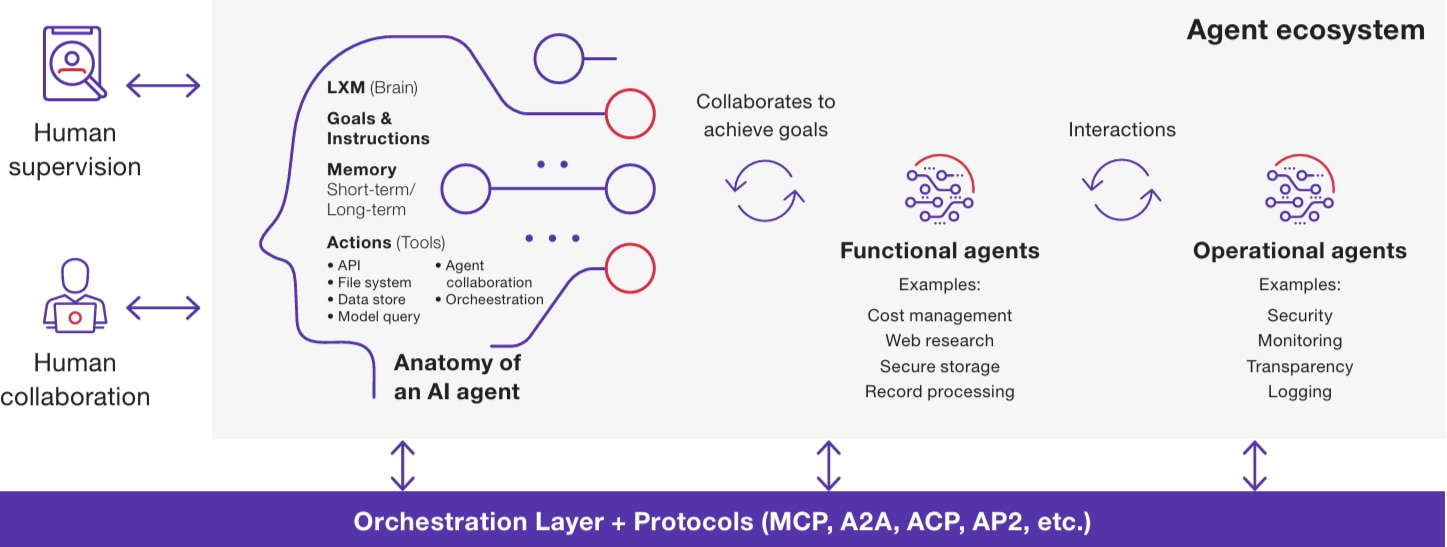
Modern agent ecosystems consist of two categories:
- Functional agents: focused on domain tasks such as code analysis, generation and documentation
- Operational agents: focused on monitoring, security, governance and compliance
These systems operate within orchestration layers that manage interactions, tool usage and execution boundaries. Critically, effective agent systems are not autonomous in isolation.
Recent work characterizes agentic AI as orchestrated systems operating within defined constraints, supported by human oversight for high-impact decisions and governance mechanisms that aim to ensure reliability, security and regulatory compliance (Roychoudhury et al., 2025; see also Subramanya, 2025).
A note on trust: Recent research on the trustworthiness of AI software engineers emphasizes that programming with trust, encoding developer intent and implementing constraints and validation mechanisms are central to enabling reliable agent behaviors (Roychoudhury et al., 2025; Aleti et al., 2026). This fundamentally transforms engineering teams from task executors into system designers and orchestrators.
How are organizations moving from tools to agent-native software delivery?
Software development is evolving through three distinct phases:
- Manual engineering: Human-written code, human-executed processes
- Tool-assisted workflows: AI as a productivity accelerator within existing processes
- Agent-native systems: Humans shift from execution to direction; delivery cycles compress; value vs. output becomes the primary metric
Many organizations currently operate between manual engineering and tool-assisted workflows, using AI tools to accelerate existing workflows without redesigning them. The gap between phase two and phase three is where most enterprise transformations stall.
“The primary constraint is no longer coding capacity—it is system design, context quality and orchestration maturity.”
Roychoudhury 2025
An example of AI agents in SDLC
In 2024, CGI started organizing traditional teams of 10–12 engineers into smaller, cross-functional pods of 3–5 individuals. As agentic technology kept improving, so did the focus of those teams on outcomes and values, and on a “hands-off keyboard” approach.
Observed patterns include:
- Faster cycle times through agent-assisted development and automation
- Increased experimentation
- Reduced delivery risk
- Higher consistency through structured validation and governance
While results vary by organization, the directional outcome is consistent: smaller, tightly aligned teams augmented by agents deliver more value with greater predictability.
Why agent-native delivery transitions stall
Failure to transition from tool-assisted to agent-native delivery is rarely a technology problem. Field studies show that productivity gains from AI vary significantly depending on how teams integrate AI into workflows and decision-making processes.
Failure to transition from tool-assisted to agent-native delivery is rarely a technology problem. Field studies show that productivity gains from AI vary significantly depending on how teams integrate AI into workflows and decision-making processes.
The common failure modes are:
- Adding AI tools to existing operating models without redesigning them
- Treating adoption as a training event rather than a sustained behavioral change program
- Measuring tool usage rather than business value delivered
- Underinvesting in the governance mechanisms needed to operate agents at scale
Context-first engineering: The core design principle
Agent-native systems rely on context: the structured set of information, permissions, constraints and rules that define what an agent knows and what it is permitted to do. Research emphasizes that encoding developer intent and system constraints is central to enabling reliable agent behaviors (Roychoudhury, 2025).
When context is poorly defined, agent outputs become inconsistent and risk increases. When context is well-curated, systems produce predictable, repeatable and auditable outcomes.
Context becomes the primary lever for scaling agent-native systems, and context curation becomes one of the most important new engineering skills.
Context includes:
- Business rules and outcome definitions
- Architectural constraints and dependency maps
- Data access policies and security boundaries
- Operational workflows and escalation paths
Context is not a precondition for agent work. It is the engineering work.
CGI AI Product Studio, 2026
Team evolution: From role silos to agent-native pods
Agent-native delivery requires small, concentrated pods built around five archetypes. These are not necessarily job titles, though they can be, but capabilities that must exist within each team. Traditional role silos accumulate handoffs; agent-native pods eliminate them.
The skill shift: Rethinking the software engineering archetypes
Like peas in a pod, tomorrow’s engineering teams are small, complementary, and inseparable — each role purpose-built for an AI-native workflow.
FROM
- Syntax
- Framework mastery
- Speedy manual repetition
TO
- Coaching & systems thinking
- Context curation
- Intent framing
- Orchestration
- Product Owner + Scrum Master + Rapid Prototyper = Intent Lead
Resist the instinct to solve; develop the discipline to define outcomes and frame agent intent. - Developer + QA + Delivery = Value Engineer
Move from direct production to supervising, validating and amplifying AI-generated output. - Business Analyst + Tech Doc + Architect = Context Engineer
Shift from consuming documentation to actively structuring knowledge for machine consumption. - QA + Business Analyst + Psychologist = Alignment Engineer
Expand the scope from defect detection to ensuring AI outputs align with human intent and values. - UX + UI Designer + Psychologist = Experience Engineer
Design for human-AI interaction patterns, trust calibration and emotional engagement
This model reduces handoffs, accelerates decision-making and increases alignment between business intent and execution, while enabling agents to operate effectively within structured environments.
Transitioning to this model requires more than a reorganization. Each archetype transition demands a genuine cognitive shift in how work is approached, prioritized and measured. The intent lead resists the instinct to solve and instead develops the discipline to define. The value engineer learns to supervise and validate rather than produce directly. None of these transitions are natural; all require sustained behavioral reinforcement to take hold.
Skills evolution: From doing to coaching
As AI systems take on more execution, human roles evolve toward higher-order responsibilities such as judgment, coordination and system design. Empirical and experimental evidence show that advanced AI can substantially increase capabilities while also producing heterogeneous and sometimes unpredictable outcomes, reinforcing the importance of human oversight and careful system design (Bubeck et al., 2023; Brynjolfsson et al., 2024).
Research on agentic AI software engineers highlights that effective use of these systems requires structured intent definition, iterative feedback and analysis loops and validation mechanisms, rather than relying on simple prompting alone (Roychoudhury, 2025).
Core skills now include:
- Coaching agents: Framing intent clearly, providing structured feedback, recognizing failure modes
- Curating context: Structuring domain knowledge for machine consumption
- Orchestrating workflows: Designing multi-agent pipelines with appropriate human checkpoints
- Validating outputs: Applying domain expertise to evaluate AI-generated artifacts against business intent
This represents a transition from task execution to system design and oversight—and it demands new mental models, not just new tools.
Skills to unlearn
This transition is as much about unlearning as it is about learning. The cognitive habits that make an experienced engineer effective in a traditional delivery model—pattern matching to known solutions, optimizing for execution speed and defaulting to direct implementation—become liabilities in an agent-native model where the highestvalue contribution is upstream of execution.
Persona-based enablement paths, rather than a single training curriculum, are required for this transformation. Models such as the HEXAD motivational model (Andrzej Marczewski, 2015) are used to identify each individual’s gamer archetype and intrinsic drivers, with role-specific learning challenges then calibrated to their current capability level. A developer transitioning to the value engineer faces a different sequence of challenges and social reinforcement mechanisms than a business analyst moving toward the context engineer archetype. This personalization is the mechanism by which new cognitive habits are built at the pace and in the context where each individual is most likely to form them.
The cognitive habit layer
Field experiments show that productivity gains from generative AI vary substantially across workers and roles, with much larger benefits for less-experienced and lower-skilled workers than for experts, underscoring the importance of how organizations integrate AI into workflows and decision-making (Brynjolfsson et al., 2024). Training enables individuals to use tools. Coaching enables teams to operate effectively. Organizations that rely solely on training often fail to scale beyond pilots.
The deeper reason for this failure is neurological, not pedagogical. The cognitive habits that make an experienced engineer effective are deeply ingrained:
- Pattern-matching to known solutions
- Optimizing for execution speed
- Defaulting to direct implementation
A one-day prompt engineering workshop does not rewire those patterns. It introduces new information on top of old behaviors, and the old behavior wins under pressure.
A behavior change framework
This is where behavioral science, habit psychology and gamification become precision instruments rather than engagement tactics. Drawing on the Cue-Action-Reward loop (Duhigg, 2012) and the Fogg Behavioral Model, daily challenges can be designed to trigger new behaviors within existing workflows, so that reaching for an AI agent becomes the path of least resistance rather than a deliberate override of an established pattern.
Critically, this journey must be personalized: using the HEXAD gamer model and Self-Determination Theory to map each engineer’s intrinsic and extrinsic motivations, then tailoring challenges, rewards and social incentives accordingly. CGI has applied this approach in enterprise adoption programs, treating behavior change as an engineering problem with the same rigor applied to system architecture.
Evidence from practice
Evidence from CGI’s internal enterprise pilot, which consisted of 331 participants over nine weeks, demonstrates what this approach produces in practice:
- 73% of initially inactive users became regular weekly AI users
- Self-reported confidence rose from 53% to 99% across the cohort
- Daily habit formation increased by 14 percentage points
- Net Promoter Score for the program reached +79.7
These are not training completion metrics. They are behavioral change metrics—the only ones that predict sustained enterprise performance in an agent-native operating model. The 2026 Anthropic 81,000person qualitative study further corroborates this: the gap between knowing AI can help and making its use a daily organizational habit is not a knowledge problem. It is a behavior-change problem and requires a behavior-change solution.
A practical approach to agent-native transformation
A structured approach to adoption typically includes four phases. These phases are not strictly sequential; governance and coaching, in particular, should begin early and run continuously, but they represent a logical progression of focus and investment.
- Context baseline
Identify and structure the key domain knowledge and constraints governing agent behavior. This is not a documentation exercise; it is an engineering discipline. Teams must determine what context agents need to produce reliable outputs, how that context should be structured and how it will be maintained as the domain evolves. - Pod redesign
Transition delivery teams into archetype-based pods. This requires more than a reorganization; it requires explicit investment in the skill transitions each archetype demands, and in the group- level coaching that enables new working patterns to take hold across a team rather than just within individuals. - Agent orchestration
Introduce agents into delivery workflows with defined contracts, context boundaries and escalation guardrails. Start with workflows where agent failure is recoverable and human oversight is practical, then expand the scope as confidence builds. Measure outcomes in business value terms, not token counts or completion rates. - Coaching and scaling
Reinforce new behaviors and expand adoption across teams. This phase is where most programs underinvest. The behaviors established during the pilot phase, reaching for agents, curating context and framing intent, must be reinforced through social proof, peer recognition and structured challenge loops before they become organizational habits. Sustained coaching at this stage is the difference between a successful pilot and enterprise.
CGI has refined this approach through enterprise adoption programs integrating behavioral science, gamification and habit psychology alongside technical delivery.
Governance by design: Accelerating agent-native delivery
As AI software engineers gain more autonomy, the need for governance increases. Recent research on trustworthy AI software engineers emphasizes the importance of transparency, accountability and mechanisms to validate and demonstrate trustworthiness in human–AI systems (Aleti et al., 2026).
Agentic software engineering guardrails
More than vibe coding, agent autonomy is engineered, layered, constrained and observable.
Reaching enterprise outcomes requires engineering discipline, context engineering and human alignment
Logic: Intent & Behavioral Control
- Policy-encoded system instructions & scoped tool access (e.g., context in md, skill files)
- Context curation
- Structured workflows & orchestrated agents
- Schema-validated outputs & fail-safe defaults
Security: Isolation & Protection
- Sandbox execution & least-privilege access
- Data protection & prompt injection defense
- Full audit logging of agent actions
Operations: Scale & Economic Control
- Cost monitoring, quotas & kill switches
- Rate limiting & model routing strategies
- Observability, drift detection & rollback
Quality: Correctness & Reliability
- Automated testing & regression harnesses
- Intent validations
- Continuous evaluation & adversarial validation
- Versioned prompts & reproducible execution
Alignment: Governance & Oversight
- Human-in-the-loop for high-impact actions
- Policy gates & business rule enforcement
- Explainability & escalation workflows
When governance is embedded by design, not bolted on as a compliance layer, it accelerates rather than constrains. Teams can move faster when they trust their guardrails. The absence of governance does not create speed; it creates hidden risk that surfaces as costly remediation.
What this means for enterprise leaders
This shift changes the fundamental question from output to value. Organizations that successfully operationalize AI will redefine delivery velocity, reshape workforce models and establish new competitive baselines. Conventional transformation programs address two layers: technical architecture and structural redesign. These are necessary but not sufficient. There is a third layer, the cognitive layer, that is equally critical and far more commonly neglected.
Three dimensions of evaluation Enterprise leaders should evaluate agent-native transformation programs on three dimensions:
TABLE
Organizations that invest only in the technical and structural layers will see pilots stall or experience slow growth. Those who invest in all three, applying the same rigor to behavior change as they do to system design, are the ones that will achieve sustained, scalable agent-native delivery.
What it takes to scale agent-native delivery
Agent-native delivery is not a tooling upgrade. It is a transformation of the operating model, team structure and the underlying cognitive habits that drive how work is performed. The three are interdependent—technical architecture without a structural redesign results in fragile agents and unclear ownership. Structural redesign without changing cognitive habits produces reorganization charts that do not change how work is done. Cognitive habit change without technical and structural foundations has no stable operating environment to land in.
Organizations that will lead in this transition are those that treat all three dimensions with equal seriousness and recognize that the third, the human cognitive element, is the most commonly underestimated factor in whether transformation reaches scale.
Industry analysis consistently finds that organizations spend approximately three times as much on change management as on the underlying technology investment to realize full value. In the context of agent-native transformation, this ratio reflects a real dependency: the structural and technical changes described in this paper require people whose instincts, defaults and daily behaviors have been formed over years of working differently. Closing that gap is not a training problem. It is a behavior-change problem that requires deliberate investment in human adoption practices applied in tandem across every technical and structural program.
Key takeaways
- Agent-native delivery is not a tooling upgrade. It is an operating model transformation that requires new team structures, new engineering practices and new cognitive habits.
- The primary constraint in AI-augmented delivery has shifted from coding capacity to context quality, system design and orchestration maturity.
- The five archetypes, intent lead, value engineer, context engineer, alignment engineer and experience engineer, define the capabilities that must exist within every agent-native pod.
- These archetypes do not emerge from a reorganization chart. They emerge from changed cognitive habits, built through deliberate reinforcement over time.
- Training enables individuals to use tools. Sustained behavioral coaching enables teams to operate in genuinely new ways. The difference between the two determines whether an SDLC pilot scales or stalls.
- Governance embedded by design across logic, quality, security, alignment and operations accelerates rather than constrains agent-native delivery.
- Enterprise leaders should evaluate transformation programs on three dimensions: technical architecture, team structure and cognitive change. Investing only in the first two leads to successful pilots but failure in scaling across the enterprise.
- The gap between knowing AI can help and making it a daily organizational habit is not a knowledge problem. It is a behavior-change problem and requires a behavior-change solution.
References
Aleti, Aldeida, et al. 2026. “Trustworthy AI Software Engineers.” arXiv preprint.
Brynjolfsson, Erik, Danielle Li, and Lindsey R. Raymond. 2024. “Generative AI at Work.” arXiv preprint.
Bubeck, Sébastien, et al. 2023. “Sparks of Artificial General Intelligence.” Microsoft Research.
CGI Product Studio. 2026. Enterprise AI Adoption: Behavioral Change at Scale. CGI Internal Research.
Duhigg, Charles. 2012. The Power of Habit: Why We Do What We Do in Life and Business. New York: Random House.
Fogg, B. J. 2020. Tiny Habits: The Small Changes That Change Everything. Boston: Houghton Mifflin Harcourt.
Huang, et al. 2026. “What 81,000 People Want from AI.” Anthropic. anthropic.com/features/81k-interviews
Marczewski, Andrzej. 2015. “HEXAD User Types.” hexad.gamified.uk
Noy, Shakked, and Whitney Zhang. 2023. “Experimental Evidence on the Productivity Effects of Generative AI.” Science.
Roychoudhury, Abhik. 2025. “Agentic AI for Software.” arXiv preprint.
Roychoudhury, Abhik, et al. 2025. “Agentic AI Software Engineer: Programming with Trust.” arXiv preprint.
Subramanya, N. 2025. “The Governance Stack: Operationalizing AI Agent Governance at Enterprise Scale.” November 20, 2025. subramanya.ai — The Governance Stac