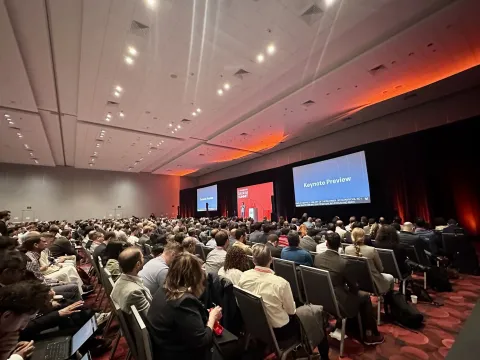
The Databricks Data + AI Summit 2025 in San Francisco brought together more than 22,000 attendees to explore the next chapter of enterprise AI. For those working at the intersection of cloud, data and AI strategy, it was more than a product showcase; it was a signal of maturity. The event made clear that organisations are moving beyond experimentation, and focusing on how to deliver scalable, secure and measurable AI outcomes.
Why Databricks still matters
Databricks was founded by the original team behind Apache Spark at UC Berkeley. In just over a decade, it’s gone from a high-performance compute engine to the backbone of the Lakehouse - a unified platform for analytics, ML and now agentic AI. It’s still opinionated, but increasingly open, modular and enterprise focused.
Across keynote announcements, technical sessions and platform updates, one theme dominated: agentic AI. These are agents that go beyond generating content - they can call tools, execute workflows and trigger actions within governed systems. It’s a future that sounds ambitious, but Databricks demonstrated meaningful progress toward making it real for enterprises.
“It’s not just about AI that talks. It’s about AI that’s traceable, secured, and embedded in existing systems.”
Daniel Amini, Cloud, Data and AI Evangelist
Key platform advancements
Several announcements stood out for their potential to simplify architecture and accelerate value.
Lakebase
Lakebase introduces a Postgres-compatible transactional layer natively within Databricks, removing the need for external databases or caching layers. This supports unified architectures with fewer moving parts - a clear enabler of operational efficiency and delivery outcomes.
“This architectural simplification represents a significant reduction in operational complexity and overhead, a valuable outcome for many CGI clients.”
Alastair Reilly, Databricks Engineer
Agent Bricks and Agent Swarms
Agent Bricks and Agent Swarms provide modular AI frameworks with observability and feedback mechanisms built in. For organisations looking to scale responsibly, these tools offer a structured way to move beyond isolated pilots.
“Agent Bricks also offers a tangible benefit - enabling faster, more repeatable deployments of generative AI with governance built in. This is what clients need to move beyond experimentation.”
Luke Hardy, Databricks Alliances Manager
Databricks Apps
Databricks Apps reached general availability, allowing secure, low-latency apps to be built natively on the platform. The addition of React support complements the launch of Databricks One - a streamlined portal aimed at business users that brings AI capabilities closer to decision-making without exposing technical complexity.
“The launch of Databricks One stood out. Designed for business users, early adopters reported a 45 per cent increase in engagement from non-technical users. This helps close the insight–action gap - a key driver of business outcomes.”
Luke Hardy, Databricks Alliances Manager
Lakeflow Declarative Pipelines and Lakeflow Designer
Lakeflow Declarative Pipelines (formerly Delta Live Tables) saw major enhancements, including native streaming (via Zerobus), expanded connectors and automated change data capture. These simplify integration challenges and reduce reliance on custom code, supporting engineering teams to deliver more, with less friction.
Lakeflow Designer introduces an AI-powered copilot for pipeline design. While still in preview, it generated considerable discussion about the potential transformation of data engineering roles over the next five years, though such predictions may be overly ambitious.
“The tool's real value lies in lowering barriers for citizen data engineers in business departments. For users with access to well-governed data through Unity Catalog who need to incorporate additional datasets for experimentation or analysis, this provides a self-service option without burdening data engineering teams.”
Alastair Reilly, Databricks Engineer
Free Edition
The improved Free Edition and university alliance programme help address the skills and adoption gap, ensuring that learners and early-stage users can engage with the full platform experience from the start.
Taken together, these developments show a shift in focus: from feature expansion to ecosystem integration, from tools to outcomes.
Responsible AI at the centre
The adoption of the Model Context Protocol (MCP), an open standard for AI agent governance, reflects Databricks’ commitment to responsible innovation. This is a positive step toward shared standards around safety, interoperability and auditability, especially as more organisations explore agent-based automation.
“Why does it matter? Because it shows Databricks is willing to align with industry practices, rather than just extending its own stack. MCP isn't the most dramatic innovation on show, but it matters for enterprise buyers who care about interoperability, and long-term viability.”
Daniel Amini, Cloud, Data and AI Evangelist
Sessions also addressed the growing need for governance in multi-agent environments, from real-time clinical applications to large-scale data pipeline orchestration. Across these conversations, a consistent challenge emerged: how to retain visibility, control and trust as AI systems grow more autonomous.
Looking ahead
The UK had a strong presence at the summit, with VisitBritain representing the national data and AI agenda on the global stage. Conversations across the expo reinforced a shared understanding: we are past the era of dashboards - the priority now is preparing platforms for AI-ready workloads, with outcomes such as compliance, observability and cost control front of mind.
“The broader strategic picture shows Databricks systematically closing the presentation layer gap. They now offer AI/BI Dashboards for visualisation, Genie spaces for natural language data queries, new Unity Catalog metrics providing a semantic layer familiar to anyone with OLAP experience, and Databricks One as the unified business portal. This creates a complete, governed experience that doesn't require users to understand the underlying technical complexity.”
Alastair Reilly, Databricks Engineer
While the momentum is promising, questions remain:
- What does cost observability look like with dozens of agents running asynchronously?
- How do we test and validate agent behaviour in a repeatable, governed way?
- Who is accountable for autonomous actions - and how do we build trust in those systems?
The Summit underscored that intelligent, governed agents are no longer a future vision. They are fast becoming operational reality. For organisations preparing to deliver business outcomes through AI, now is the time to evaluate readiness and ensuring that platform strategy is aligned with this next phase of enterprise intelligence.
“All of this signals a shift - from equipping analysts with tools to enabling intelligent systems that act on their behalf. What remains to be seen is how these concepts perform under real production pressures, particularly in relation to cost, observability and safety. These will be critical areas to watch over the next 12 months.”
Daniel Amini, Cloud, Data and AI Evangelist
Shaping what’s next: a view from the consulting alliance frontline
Luke Hardy, Databricks Alliances Manager, CGI
Having led the CGI and Databricks alliance for the past 18 months, I’ve seen the relationship evolve well beyond platform delivery. It’s now about co-creation, trust and delivering measurable outcomes for clients.
DAIS 2025 wasn’t just a showcase. It was a milestone moment. The tone has shifted: alliances like CGI are no longer delivery extensions - we are central to how innovation is realised.
The numbers speak for themselves; Databricks has seen a 50 per cent increase in its global alliance base and a 70 per cent rise in co-delivered projects. Those leading in the ecosystem are those driving sector outcomes, at scale.
For consulting alliances like CGI, the message is clear- we are not observers. We are shaping the future direction of the platform and co-delivering the outcomes that matter.