It is undeniable that the health and life sciences industries are experiencing a period of phenomenal growth and transformation. From modernizing supply chains to enhancing research and academia, technology is at the center of innovation, accelerating services and solutions to improve and advance patient care and support.
Data, data, and more data
“There were 5 exabytes of information created between the dawn of civilization through 2003, but that much information is now created every two days” - Eric Schmidt, former CEO of Google.
It is said that data is the lifeblood of progress in health and life sciences, as it is the foundation for evidence-based medicine, personalized care, and the development of life saving treatments. Sources of data include, but are not limited to:
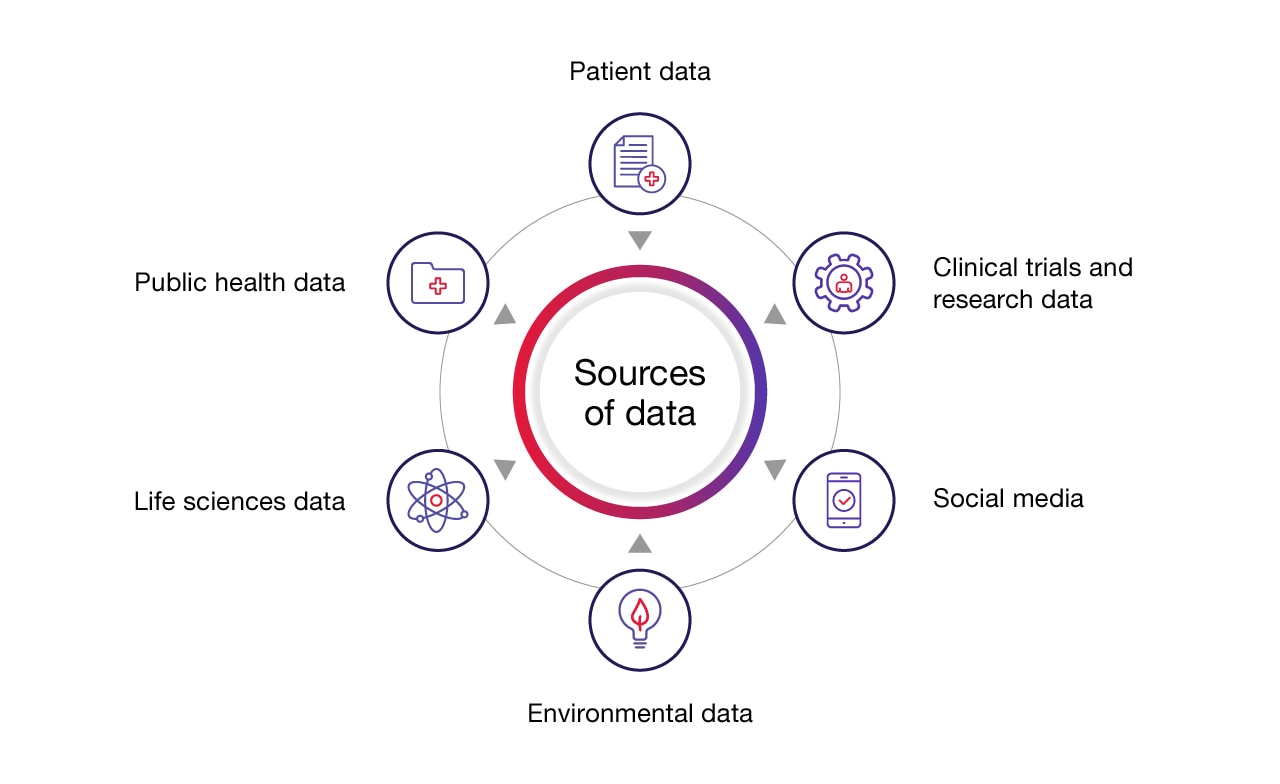
- Patient data: by way of electronic health records (EHR), patient surveys and reports, and also medical devices, wearables, and digital health tools.
- Clinical trials and research data: via studies generating data on safety, efficacy, treatment protocols, genomic data, and so called ‘real world data.’ Information collected from insurance claims for example, create further insights into treatment effectiveness.
- Public health data: disease surveillance, vaccination records, socioeconomic data.
- Life sciences data: molecular structures, protein interaction, biomarker research, and even data from animal studies and their potential on human trials.
- Environmental data: capturing and factoring in the linkages between environmental factors and health outcomes.
- Social media: a proven data source that is influential in disease outbreaks and public health trends.
Big data analytics tools can help extract valuable insights from this data, leading to improved diagnosis, treatment, and overall health outcomes, but organizations around the world still wrestle with policy implications including secure storage, access, sharing, privacy, security, and interoperability.
An excellent example of capturing and using valuable data insights to help life sciences clients reduce errors, manufacturing costs, and time to market is our global partnership with Körber and their PAS-X Manufacturing Execution System (MES) Suite, which delivers a comprehensive view of data from diverse integrated systems.
With big data and AI come big opportunity and responsibility
AI is rapidly transforming all industries across all sectors. Within health and life sciences, examples include:
- Analysis of medical data: AI can analyze sizable amounts of medical data to identify patterns, predict disease risks, and personalize treatment plans.
- Assistance with diagnosis: AI-powered tools can help doctors analyze medical images for early detection of diseases like cancer.
- Drug discovery and development: AI algorithms can accelerate the process of drug discovery and development by analyzing complex molecular structures and predicting potential drug candidates.
Navigating the opportunity, complexity and uncertainty of AI requires proven methods that integrate scientific rigor into solution design and implementation to create business value and shape a positive human-centric future. It requires a responsible AI framework that empowers organizations to realize the benefits of AI, aligning to their values and ethical principles for the betterment of societies.
A prime example of ethically developed AI is a new test solution to support radiologist decision-making at Helsinki University Hospital. In collaboration with CGI and Planmeca, a leading manufacturer of high-tech digital imaging devices, the hospital is developing an AI solution that assists radiologists in interpreting brain CT scans and detecting the most common types of non-traumatic brain hemorrhages. This implementation leverages responsible use best practices by ensuring a “human in the loop” approach.
Navigating the road ahead
Data and AI are only elements of the expansive and dynamic nature of the health and life sciences landscape. As these fields continue to evolve, we can expect even more breakthroughs that will revolutionize the way we prevent, diagnose, and treat disease. The future of healthcare is undoubtedly personalized, data-driven, and technologically advanced, all with the goal of improving human health and well-being.
These fundamentals help define and advance complementary trends such as precision medicine and personalized care, connected care via telehealth and virtual care platforms, preventative care, and population health. It is all rooted in collaboration and partnerships — from pharmaceutical companies and research institutions to technology giants — and it is crucial to accelerate innovation and bring new treatments and technologies to the market faster.
The adoption of new technologies has long required a common set of imperatives for action to move beyond hype to tangible value. These actions are even more critical as we face the next wave of innovation with generative AI, frontier AI, and evolutions beyond. At CGI, we believe there are four AI imperatives for action that help us guide organizations to enable trusted outcomes at any stage of their AI maturity.
Leveraging integrated technologies and data-driven insights to transform health and change lives
Across healthcare and life sciences, adopting integrated technologies and data-driven insights can accelerate advancements in people-centric care from research to prevention and treatment. By leveraging these innovations to advance human health and well-being, we can create a collaborative health and life sciences ecosystem where innovators, providers, researchers and patients seamlessly connect.
About this author

René Lykkeskov
Vice-President, Consulting Services
René Lykkeskov partners with global organizations across highly regulated industries—including pharma, life & food sciences, and energy & utilities—to drive digital transformation, technology modernization, supply security, production optimization, and OT/IT security. He leads CGI’s global Manufacturing Execution Systems (MES) Community, a cross-functional network that promotes ...