













Supporting governments in building climate resilience for five decades

Around the world, government agencies are being called to make faster, more informed decisions to protect people and infrastructure as extreme weather events increase in frequency, scale and complexity. From floods and wildfires to hurricanes and storm surges, the need for swift action has never been greater.

Wildfire in a cornerstone

For 50 years, we have helped public sector leaders anticipate, prepare for and recover from natural disasters. We deliver outcomes: earlier warnings that save lives, clearer intelligence in emergencies and more transparent recovery.

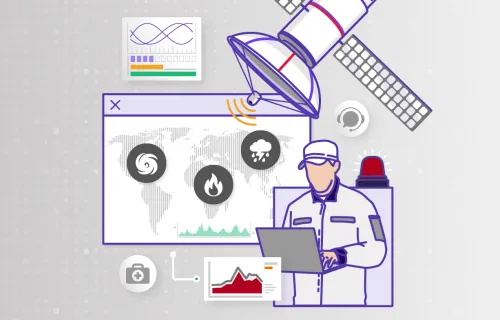
Today, our clients apply these capabilities to detect risks sooner, coordinate response and oversee relief funding, an evolution that began when environmental and space agencies first used satellite data to improve forecasting.

A foundation built on foresight

For decades, agencies have expanded early warning and recovery capabilities using satellite data, predictive analytics and modernized grant systems. We help clients operationalize environmental intelligence and manage large scale recovery programs.

That expertise now supports:

  • Missions for 200+ satellites, enabling advanced forecasting across regions
  • 99.995% reliability and <10 minutes of downtime for major flood control operations in the Netherlands
  • AI-powered wildfire mapping adopted across Australia, Europe and North America
  • Over US$8 billion in recovery funds disbursed and 450+ American Rescue Plan Act programs tracked across New Jersey through the SIROMS platform
  • Transparency and oversight for more than US$80 billion in assigned recovery funding, including US$38.8 billion in obligated funds, in Puerto Rico

These figures underscore the outcomes our clients achieve and the systems that strengthen community resilience as climate risks accelerate.

Strengthening readiness at global scale

Across Europe, Asia Pacific and North America, agencies are advancing predictive capabilities to keep pace with unpredictable weather. Through collaborations such as the European Space Agency’s eSurge initiative, we help clients expand access to satellite intelligence and improve storm surge modeling for stronger preparedness.

Environmental authorities use our AI-enabled wildfire mapping to assess burn severity, track fire progression and guide land management decisions. By combining cloud processing with Earth observation data, these tools give agencies insight to act on quickly during critical incidents.

In the Netherlands, officials responsible for the Maeslant storm surge barrier, one of the world’s largest moving flood control structures, use BOS (Beslis & Ondersteunend Systeem), an automated decision-support system we helped develop. Its reliability helps safeguard Rotterdam and surrounding regions during severe storm events.

Accelerating recovery for communities in crisis

When disasters strike, recovery can span months or years. Governments are modernizing systems to deliver aid faster and reduce administrative burden. The State of New Jersey’s initiative reflects this shift. We support the state as it modernizes systems and processes—capabilities that help manage billions in funding and track hundreds of programs.

Across the U.S., recovery programs supported by our technologies have aided responses to major disasters, including Hurricanes Katrina, Sandy, Irma and Maria. In Puerto Rico, the PR Disaster Recovery Solution (PR DRS) provides life cycle visibility and integrity across obligated funding, helping officials maintain oversight and trust during long-term rebuilding.

These systems help agencies simplify processes, ensure accountability and deliver support to citizens when needed most.

Acting smarter when every second matters

For agencies coordinating rescue operations, real-time information can determine outcomes. International search-and-rescue teams use the CGI Sense360 situational awareness platform we developed with emergency responders to combine satellite imagery, drone feeds, geospatial inputs and infrastructure data into a single operational picture. These tools support quicker decisions and safer missions during earthquakes, floods, tsunamis and wildfires.

Following a disaster, agencies use Earth observation analytics to assess damage, identify hazards and monitor conditions. Because satellite data is not limited by weather or daylight, these insights help governments respond sooner and more safely, even in inaccessible or dangerous areas.

Building resilience for the future

Natural disaster management is about protecting people, homes, essential services and the environments communities depend on. Governments continue to evolve their approach as climate conditions shift and new threats emerge.

Thanks to the leadership and dedication of the clients and organizations we partner with, communities are stronger and better equipped for the challenges ahead. We are honored to support their missions and help build resilience for future generations.

Learn more about our Government industry


Discover more industry impact stories