
The migration to ISO 20022 is no longer a future milestone, it is now operational reality. The more important question is no longer whether banks can send MX messages, but whether structured data has been embedded as a foundational design principle across payments architecture, core systems, governance and customer channels.
That question becomes particularly relevant ahead of the November 2026 Swift Standards Release, when unstructured postal address fields will be retired across CBPR+, HVPS+ and other payment networks.
The UK’s CHAPS high-value payment scheme at the Bank of England (BoE) has transitioned its RTGS system to ISO 20022 (Swift MX), replacing legacy MT103 and MT202 messages. For its 30+ direct participants, MX messaging is now embedded in daily operations.
For many institutions, regulatory ISO 20022 compliance acted as a catalyst for broader payments modernisation. Whether or not formal migration programmes have now closed, 2026 may prove to be the most consequential year yet in that journey.
The ‘Strangler Fig’ approach to modernisation
To meet regulatory deadlines while managing legacy estates, many banks adopted a ‘strangler fig’ approach, introducing MX APIs and incremental services around existing core systems. Over time, legacy functionality is progressively replaced until a fully MX-native model supports enriched ISO 20022 data end-to-end, maintaining operational continuity during transition.
However, the downside of the strangler fig approach is increased short-term complexity. Running legacy and MX-native services in parallel adds operational overhead, extended testing cycles and additional governance layers.
In a domain where regulatory and market-driven change is constant, the risk is not failure of design, but exhaustion of delivery capacity. The pace of change can outstrip the pace of re-architecting.
Structured address enforcement
From November 2026, structured address enforcement represents a further step towards harmonised, data-rich payments infrastructure, with implications for market-wide operational resilience and participant readiness.
For corporate clients submitting bulk files or cross-border payments, this marks a material shift in data quality expectations.
Banks must ensure that:
- Customers understand that structured address data must be provided in payment instructions (for example, beneficiary addresses).
- Payment channels mandate and validate the required data elements.
- Reference data repositories contain structured town name and country code information for customer and counterparty records.
- Status reporting and operational processes are prepared for potential increases in rejection volumes.
Even a modest uplift in rejection rates could generate disproportionate operational workload, client escalation and reputational risk if not anticipated early. Few banks will wish to reject legitimate customer payments, particularly in cross-border or high-value scenarios where visibility is high.
Multi-scheme complexity in the UK
The challenge becomes more nuanced in the UK context.
Banks will need to implement scheme-aware validation, routing logic and clear customer communication across all channels. Without careful design, differences in validation thresholds could result in uneven customer experiences or operational friction.
Payments frequently originate in bulk files containing instructions routed across multiple clearing schemes - CHAPS, Faster Payments and Bacs - which do not evolve in lockstep and operate using different technical standards. These files are typically generated by corporate treasury systems and ERP platforms. As illustrated in Figure 1, common UK payment use cases such as house purchases, retail transfers and salary payments may be settled through different schemes depending on value, urgency and business context. Divergence in validation standards or enforcement timing may therefore have direct implications for corporate processing, reconciliation and liquidity management.
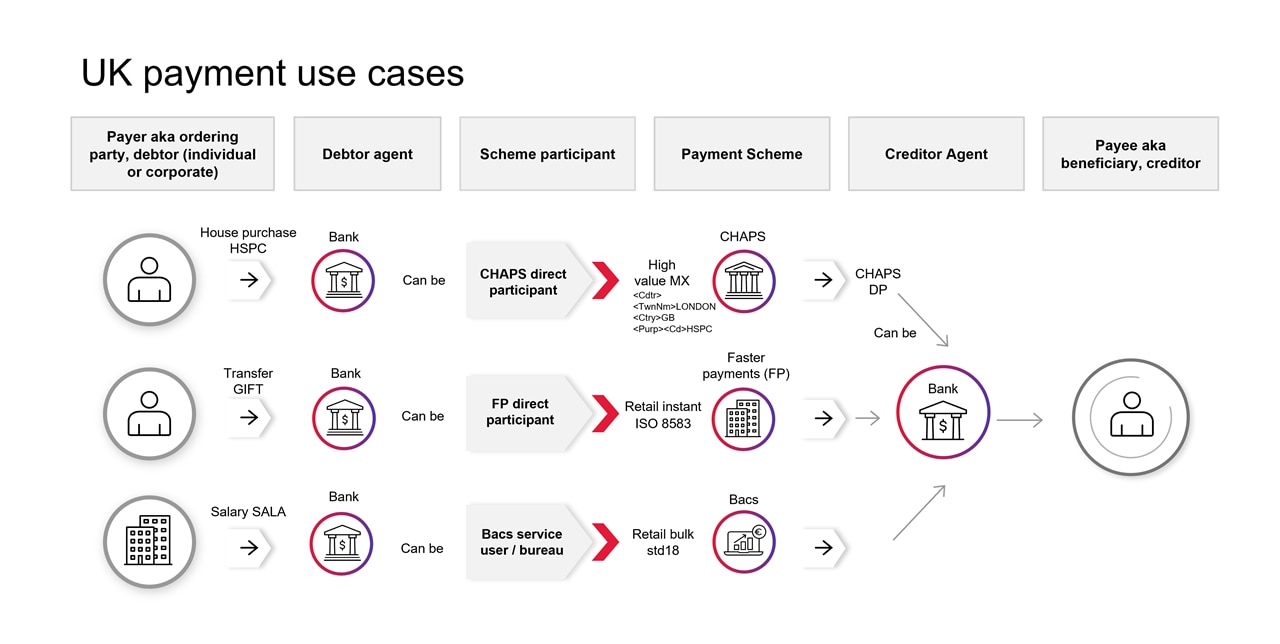
The issue is not compliance within a single scheme. It is maintaining coherence, resilience and clarity across a multi-scheme environment. For market infrastructures and participants alike, the focus shifts from format migration to sustained data governance across the payment lifecycle.
Coordination across schemes and participants will be essential to ensure that enforcement milestones strengthen, rather than fragment, the UK payments ecosystem.
Will banks retain legacy formats?
Faced with these challenges, some banks may consider continuing to support legacy payment instruction formats, introducing compensating controls rather than pursuing deeper core rationalisation.
AI solutions may also be explored to derive structured town name and country code elements from unstructured address data. While such tools may assist with data enrichment, they do not remove the need for robust data governance, explainability and customer transparency.
AI-driven data manipulation may, in some cases, prove less predictable than traditional transformation and mapping approaches. Without appropriate controls, this could expose banks to regulatory risk and potential fines.
The underlying question is whether incremental modernisation remains sufficient, or whether structured data enforcement marks a tipping point requiring more decisive core rationalisation.
Beyond compliance
This year represents more than another standards release. It is a test of whether payments architecture and data governance throughout bank systems are aligned to a structured ISO 20022 future.
Alongside other ongoing initiatives, including the UK government’s National Payments Vision, purpose of payment codes, structured remittance and evolving investigation message requirements, the industry faces a sustained period of payments transformation.
As explored in another recent CGI perspective on the Impending payments compliance avalanche, institutions are also navigating cumulative pressures across sanctions screening, AML controls and cross-border transparency. Together, these trends signal a structural shift: data governance is becoming central to operational resilience. Success will depend on treating structured data not as a compliance obligation, but as a foundational design principle embedded across channels, schemes and customer journeys.
At CGI we work across UK payments infrastructure and financial institutions, supporting ISO 20022 transformation, multi-scheme architecture design and data governance evolution. We help organisations move beyond technical compliance to build payments architectures that remain resilient and adaptable as regulatory and market expectations continue to mature.
2026 will not simply be demanding. It will be defining for how structured data is governed across the payments ecosystem.
Looking ahead
Structured address enforcement is unlikely to be the final data milestone. As important as data standards are, they represent only one dimension of a much broader challenge: how the UK’s core retail payment systems, built around legacy assumptions and formats, can evolve to support a truly future-ready ecosystem.
In the next instalment of this series, we step back from messaging standards and data governance to examine the retail payments landscape that exists ahead of the UK’s National Payments Vision (NPV). We consider how decades of system design, from Bacs’ Standard 18 record format to Faster Payments’ early real-time architecture, have shaped both capability and constraint, and where opportunities for innovation and redesign may emerge as NPV progresses.
About this author

Neil Cannon
Payments Subject Matter Expert
Neil has deep experience delivering strategically critical payments transformation programmes across industry bodies, clearing houses and global banking institutions. He has operated at the heart of global payments infrastructures, leading business analysis and SME engagement across large-scale ISO ...