
If you want to understand a bank, don’t start with the branch or the app.
Sit with the ops team at 3pm on a Friday. That’s when the real picture emerges: unstructured inbound messages, sanctions alerts piling up, onboarding packs missing key documents and experienced staff manually processing routine transactions.
Despite decades of investment in automation, many transaction banking operations still depend heavily on human effort to manage exceptions, interpret information, and coordinate complex processes at scale. Much of the work still begins with someone reading a message, document or alert and trying to work out what it means.
As volumes grow, so do onboarding delays, investigation workloads, operational exceptions, and compliance overheads. Workflow platforms, APIs, and RPA remain essential foundations, but they were designed for structured processes and deterministic rules.
The operational challenge begins in the messy middle where work becomes unstructured, ambiguous, and exception heavy. This is where AI creates real value: not by replacing controls, but by reducing the operational cost of interpretation, investigation, and manual coordination at scale. In doing so, it brings greater speed, consistency, and scalability to processes that have resisted every previous wave of automation.
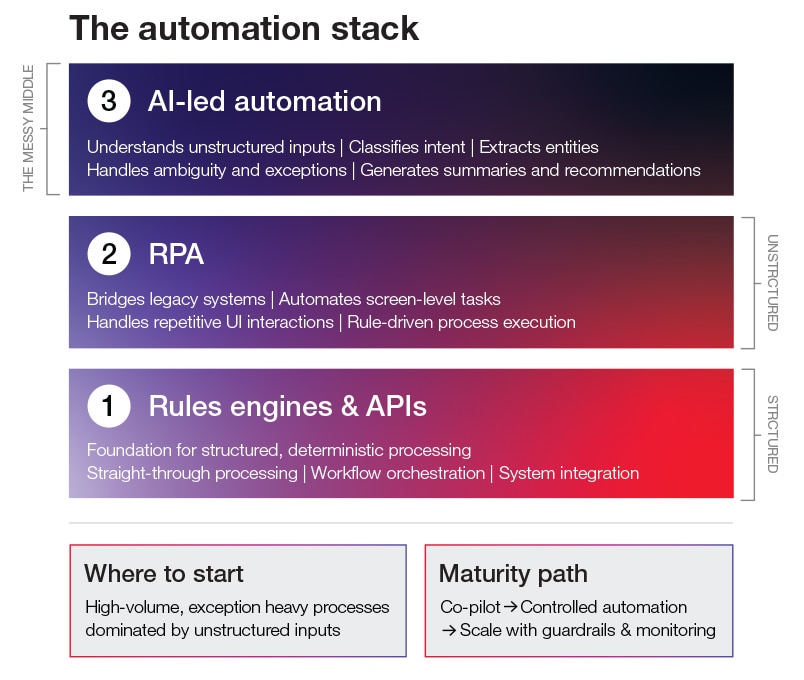
As shown in Figure 1, AI does not replace existing automation layers. It complements them by helping operations teams interpret information, manage exceptions, and structure unstructured work before it reaches downstream processes.
Three areas illustrate where the impact is clearest.
1. Corporate onboarding
Onboarding a corporate client into transaction banking is document-heavy, iterative, and fragmented across teams.
McKinsey’s research1 puts the average at up to 100 days. That’s revenue sitting idle, relationship managers fielding client frustration, and competitors who onboard faster winning the next mandate.
AI removes the low-value grind that causes delays: reading onboarding packs, extracting structured data, checking completeness against policy, and flagging what’s missing before a reviewer even opens the file.
This reduces the endless back-and-forth. It’s not a fancier workflow tool, but a layer that reads, understands, and pre-processes so people can focus on decisions.
2. Trade finance operations
A significant share of trade operations starts with unstructured inbound communication: discrepancy discussions, status queries, amendment requests. Parts of the SWIFT standards deliberately include free-format messages for exactly this kind of traffic (e.g. MT799/MT999), and routing those messages to the right team is manually intensive, expensive, and error-prone.
AI changes the starting point. It classifies intent, extracts key references, and produces a structured work item with a summary and recommended routing, before a human touches it.
The result is fewer misroutes, less rework, and measurably shorter turnaround times. For high-volume trade messaging, this is where the economics of AI become visible fastest.
3. Sanctions screening
Screening engines already do their job. The real operational pain sits downstream after the alert is generated, in triage, investigation, and documentation, where compliance analysts spend most of their day clearing false positives. For many institutions, this has become a compliance tax that scales with transaction volume rather than with actual risk. The challenge is no longer detecting more alerts but resolving low risk cases with far less manual effort while maintaining consistency and auditability.
A 2025 Federal Reserve staff paper2 found that LLMs reduced sanctions screening false positives by 92% and improved detection rates by 11% versus the best-performing fuzzy-matching baseline.
That doesn’t eliminate human review, it transforms the economics of it. Analysts can focus on cases that genuinely require attention, investigations become more consistent, and the documentation trail improves because the AI provides structured evidence instead of relying on manual write-ups after clearing dozens of routine alerts each day.
Start smart, scale with guardrails
The Bank of England’s joint survey with the FCA3&4 found that while 55% of AI use cases involve some autonomous decision-making, only 2% are fully autonomous. That’s the right maturity path for transaction banking: co-pilot first, controlled automation second, scale third, with policy boundaries, confidence thresholds, and audit trails throughout.
If you’re deciding where to start, resist the flashiest use case. Find a process that is high-volume, exception-heavy, and dominated by unstructured inputs. Measure impact in turnaround time, rework rate, and throughput. Workflow and rules remain the foundation. RPA still earns its keep. But for the messy middle, where cost, risk, and client friction quietly accumulate, AI is no longer optional. It’s the layer that makes the rest of the stack work.
Next in this series: how agentic AI reshapes the operational model, and what that means for the teams running transaction banking today.
Sources
1 McKinsey & Company, “Winning Corporate Clients with Great Onboarding” (October 2022). www.mckinsey.com
2 Allen, J.S. & Hatfield, M.S.S., “Can LLMs Improve Sanctions Screening in the Financial System?” FEDS Working Paper 2025-092, Federal Reserve Board (September 2025). www.federalreserve.gov
3 Bank of England & FCA, Artificial Intelligence in UK Financial Services — 2024 (2024). www.bankofengland.co.uk
4 Bank of England, Financial Stability in Focus: AI in the Financial System (April 2025). www.bankofengland.co.uk
About this author

Amol Aloni
Director Consulting Expert
Amol Aloni is a senior consulting leader specialising in corporate and transaction banking transformation for global banks. He advises clients on modernising trade finance, supply chain finance, working capital and lending businesses, combining deep product expertise with strong technology and operations delivery experience. Working ...