Enterprise AI moves into its next phase: reflections from Databricks Data + AI Summit 2026
If there was one message that emerged from this year's Databricks Data + AI Summit, it was that enterprise AI is entering a new phase.
The conversation is no longer centred on whether AI works. Most organisations have already demonstrated that it can deliver value in controlled environments. The challenge now is scaling AI across the enterprise in a way that is governed, trusted and commercially sustainable.
That shift was evident throughout the Summit. Rather than presenting a series of disconnected product announcements, Databricks shared a clear vision for how data, AI, governance and business applications come together to create an enterprise platform for the next generation of AI-powered organisations.
For CGI, this reinforces where we can help clients most – building trusted data foundations, establishing effective governance, and scaling AI with confidence.
As a Databricks Gold Partner delivering solutions across Microsoft Azure and AWS, we help organisations modernise their data estates, strengthen governance, and turn AI investment into measurable business outcomes. The Summit reinforced that these are increasingly the conversations our clients want to have.
From technology adoption to business capability
For several years, AI discussions have focused on models, experimentation and technical capability, and those capabilities remain important. Success, however, increasingly depends on how consistently organisations apply them across the business.
Those that will succeed over the coming years will operationalise AI across business functions, supported by trusted data, clear governance and effective operating models.
Databricks' keynote captured this shift through four themes: Context, Choice, Cost and Control.
Together, these themes describe what enterprise AI now requires – access to trusted business data, flexibility in model selection, visibility of AI consumption, and governance that enables confident innovation while managing risk.
Max Martin, Senior Consultant at CGI, noted that many of the Summit announcements reflected a common theme: AI agents become significantly more valuable when they understand enterprise context through trusted organisational data rather than operating in isolation.
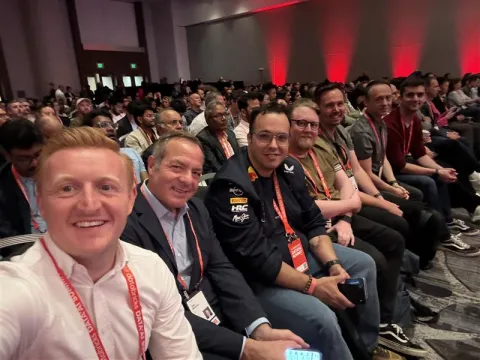
Across our delegation, there was broad agreement that these themes reflected a wider shift in client conversations. Rather than asking what AI can do, organisations are increasingly focused on how to operationalise it securely, integrate it with existing business processes and demonstrate measurable value.
The data platform becomes the foundation for enterprise AI
One of the most significant themes from this year's Summit was the changing role of the enterprise data platform.
Historically, platforms were designed primarily for analysts, dashboards and engineering workloads. Increasingly, they must also support AI agents and business applications that reason over enterprise data, generate outputs, trigger workflows, and interact directly with operational processes.
Artir Geci, CGI's Databricks Technology Director, believes this represents a fundamental architectural shift.
"AI agents are becoming primary users of the data platform, driven by enterprise applications. The platform no longer serves only analysts and engineers. It must now support agents that reason over data, create outputs, trigger workflows and operate safely within business processes."
For Artir, the keynote's emphasis on Context, Choice, Cost and Control reflects exactly what organisations need to deploy AI safely at scale.
He describes the relationship simply:
"Agents and enterprise apps are the aircraft. The data platform is the runway and control tower. Without trusted data, governance, monitoring and operational discipline, they cannot take off safely or repeatedly."
It is a useful way to view enterprise AI. Success depends not only on increasingly capable models, but also on trusted data, effective governance and the operational foundations that allow organisations to scale AI with confidence.
Governance is becoming the competitive advantage
Perhaps the strongest commercial message from the Summit was that governance is rapidly becoming the differentiator.
As AI adoption accelerates, organisations face increasingly complex questions around access, security, accountability, regulatory compliance and cost management. These are no longer purely technical concerns. They are business challenges requiring executive attention.
Announcements including Unity AI Gateway and continued investment in Unity Catalog demonstrate that governance is becoming embedded within the AI platform rather than treated as an afterthought.
From our perspective, these developments make it easier to establish the governance frameworks needed to scale AI responsibly.
As Jason Cruz, CGI's Databricks Centre of Excellence Lead, observed:
"The opportunity for CGI is not proving we can build agents, everyone can now. It is being the people who can demonstrate that the controls are real."
That focus on governance was echoed by other CGI delegates throughout the Summit. Several observed that discussions with clients are increasingly centred on operating models, accountability and trust, rather than model performance alone.
That reflects a broader shift in client priorities. The question posed is whether AI can be governed, audited and trusted, rather than merely deployed, as it becomes embedded in critical business processes.
Simplifying the modern data estate
Alongside AI, the Summit also demonstrated how rapidly the Databricks platform continues to evolve.
Announcements including Lakebase, Lakehouse//RT and LTAP point towards a future where transactional and analytical workloads become increasingly integrated, reducing architectural complexity while supporting real-time business operations.
For many organisations, these developments could prove just as significant as the AI announcements themselves.
Large enterprises continue to manage fragmented platforms, duplicated data and multiple integration layers built over many years. Modernising these environments reduces operational complexity while creating the trusted, responsive data foundation that enterprise AI increasingly depends upon.
Leigh Chilcott, CGI Data Engineer, also highlighted the growing convergence between operational and analytical platforms. Rather than maintaining separate systems for transactional and analytical workloads, organisations now have an opportunity to simplify architectures that have evolved over many years, reducing complexity while creating stronger foundations for AI.
Rather than discussing AI in isolation, the Summit reinforced that platform modernisation and AI adoption are becoming two parts of the same transformation.
AI reaches the wider business
Another notable development was the increasing emphasis on business users rather than specialist technical teams.
Capabilities such as Genie One and Genie Code demonstrate how AI is becoming accessible across finance, operations, customer service and other business functions, allowing employees to work more naturally with trusted enterprise data.
This matters because organisations realise the value of AI through business adoption, not technology deployment alone.
Paul Sandford, Software Engineer at CGI, observed another important shift. For many years, Databricks has largely been viewed as a platform for data specialists. This year's Summit suggested a much broader role, positioning it as a platform for software engineers, architects, consultants and data professionals alike. As AI becomes embedded across software delivery, analytics and business operations, the platform's relevance extends far beyond traditional data teams.
When AI helps customer service teams respond more effectively, finance teams improve forecasting, or operations teams identify issues sooner, the conversation shifts from technical capability to measurable business performance.
Helping clients scale enterprise AI
Taken together, this year's announcements reinforce that enterprise AI is maturing.
Clients increasingly want practical answers to fundamental business questions rather than isolated demonstrations of AI capability.
Which use cases will deliver measurable value? How should AI be governed? How can organisations modernise existing data estates while continuing to operate? What operating model is needed to move from pilots into production?
These are precisely the challenges we are helping clients solve.
CGI’s partnership with Databricks combines technical expertise, industry knowledge, governance capabilities and large-scale delivery experience. Together, these strengths help clients move confidently from experimentation to operational AI.
Looking ahead
The most valuable insight from this year's Summit was not a single product announcement.
It was the recognition that enterprise AI is becoming part of core business operations.
AI must be connected to trusted enterprise data, embedded within business processes and governed with the same discipline as every other critical technology capability.
The real work starts now. It is not AI for the sake of AI, or platform modernisation for its own sake. It is a governed path from enterprise data to agents, from agents to applications, and from experimentation to measurable business value.
That is where the conversation has moved, and where we are helping clients turn enterprise AI into measurable business value.