
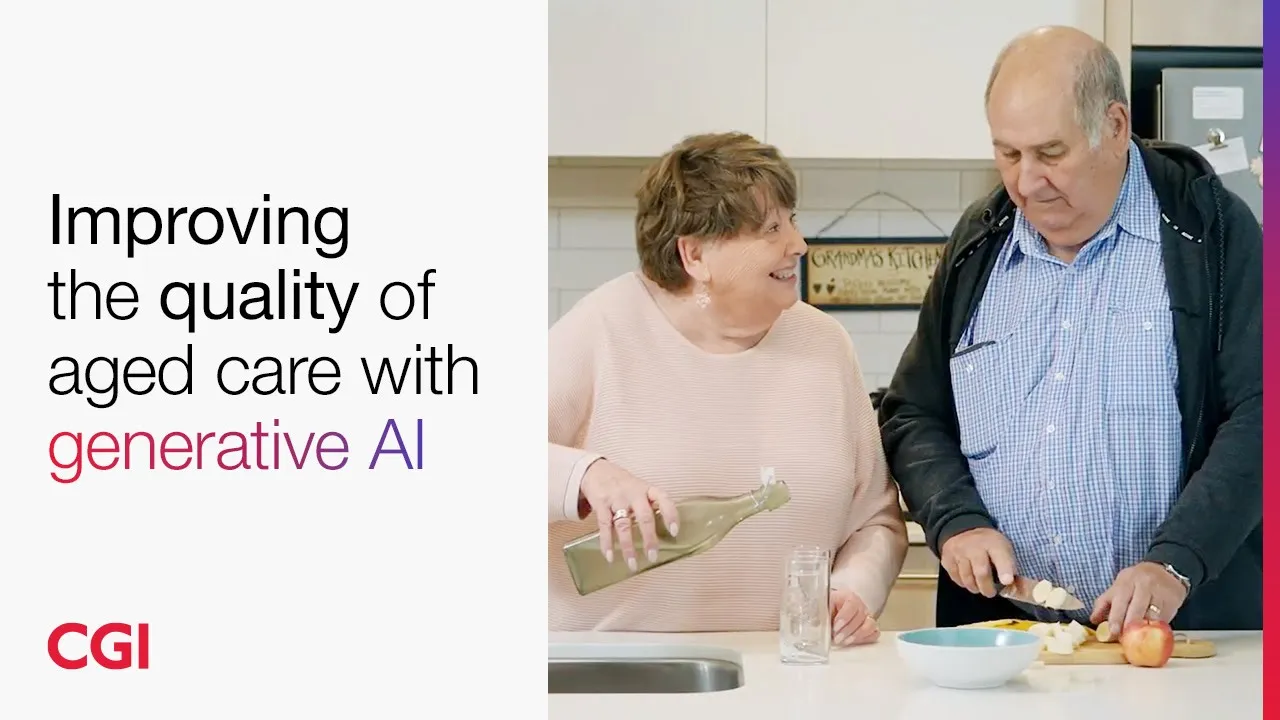
To play this video, enable Statistics cookies. Google/YouTube may process your data – Learn more.
Supporting better aged care across Australia
We’re partnering with Ageing Australia to help transform aged and community care services across Australia. Together, we’re helping aged care organisations address the challenges facing their critical workforce, improve outcomes for our ageing population and deliver better quality care.
Our specialist solutions and innovations enable the responsible and auditable use of artificial intelligence, data and intelligent automation. These technologies help organisations improve how they plan and deliver care, while reducing the growing burden of administrative and compliance obligations.
By streamlining processes and reducing time spent on administration, we help care teams spend more time supporting clients and delivering person-centred care.
 |
Aged care providers are under pressure to deliver higher-quality care, manage rising operational complexity, and keep services sustainable.
The introduction of the Support at Home program has accelerated change across the aged care sector. Providers must now recover more operational costs through service pricing while adapting to new funding arrangements, increasing compliance requirements and greater administrative complexity. At the same time, they continue to balance quality care with financial sustainability.
That is why many providers are looking for practical ways to improve care planning, reduce manual work, and connect the systems and processes that support day-to-day service delivery.
Organisations across the sector are facing common challenges:

Administrative burden
Manual processes reduce the time care teams spend with clients.

Care planning
Time-intensive documentation makes it difficult to deliver consistent, high-quality care.

Compliance pressure
Support at Home has increased governance, reporting and operational complexity.

Workforce visibility
Limited rostering and service coordination reduce operational efficiency.

Funding & pricing
New funding models are increasing pressure on pricing, budgets and cost recovery.

Disconnected systems
Siloed information creates duplication, delays and inconsistent data
As providers adapt to new programs, improving productivity is becoming just as important as meeting compliance obligations. Reducing administration, connecting information across systems and giving care teams more time with clients are now critical to delivering sustainable, high-quality care.
The role of AI in Aged Care
The challenges facing aged care providers cannot be solved by technology alone. However, artificial intelligence is emerging as a practical way to reduce administrative burden, improve consistency and support better decision-making.
When applied to the right processes, AI can help providers:
- Reduce time spent on repetitive administrative tasks
- Improve the quality and consistency of care planning
- Automate assessment and documentation workflows, including the Integrated Assessment Tool (IAT)
- Connect information across existing care management systems
- Enable care teams to spend more time with clients

Delivering real world outcomes
At CGI, we work with aged care providers to identify practical opportunities to apply AI where it delivers measurable value, improving operational efficiency while supporting better outcomes for staff and clients.
For ECH, a South Australian Aged Care provider, we created a generative AI solution which automated the care planning process, reducing care planning creation time from 20 minutes to 36 seconds, while improving accuracy and consistency.
Our solution now enables staff to spend more time delivering quality care to their clients by reducing the need for manual administration.
Per year, ECH now save
3,068 hours
in generating care plans, allowing care teams to spend more time delivering person-centred care.
Care plan compliance increased from
35% to 85%
improving care quality, clinical decision-making, and continuity of care.
Per year, ECH are projected to gain
$138K +
creating capacity to reinvest in frontline care and strengthen financial sustainability.



Talk to our aged care specialists
If your organisation is dealing with rising administration, care planning complexity, compliance pressure or the need to improve operational efficiency, we can help.
Talk to our experts to explore how AI can reduce administration and improve productivity in your aged care organisation.