


Organizations today operate in an increasingly complex and interconnected digital environment. As businesses accelerate digital transformation, adopt cloud technologies, and enable hybrid work, the traditional boundaries that once defined enterprise security have all but disappeared.

At the same time, cyber threats are evolving rapidly, becoming more sophisticated, more targeted, and easier to execute. In this new reality, traditional perimeter-based security models are no longer sufficient.

“In today’s world, attackers don’t breach in — they log in.”
— Subin Alexander, Director, Consulting- Delivery, CGI


Why Zero Trust matters now

The shift toward distributed environments has fundamentally changed how organizations must think about security. Identity, not the network, has become the primary attack surface.

Cybercriminals increasingly rely on credential theft, phishing, and impersonation to gain access to systems. Once inside, they move laterally across environments, escalate privileges, and access sensitive data, often without being detected.

This is why Zero Trust has emerged as a critical security model.

“Identity is the new perimeter.”
— Subin Alexander

A strategic shift in cybersecurity

Zero Trust is not a single product or technology. It is a strategic approach built on a simple principle: “never trust, always verify.”

Rather than assuming that users or systems within a network are trustworthy, Zero Trust requires continuous validation of identities, devices, access, and data.

“Implicit trust is one of the largest vulnerabilities organizations have today.”
— Subin Alexander

This model reflects the reality that threats can originate from anywhere, both inside and outside the organization.

Reducing risk by limiting impact

A key advantage of Zero Trust is its ability to contain and minimize the impact of cyber incidents.

By implementing controls such as least privilege access, segmentation, and continuous monitoring, organizations can significantly reduce lateral movement within their environments.

“The impact of an attack can be significantly reduced if Zero Trust is implemented thoroughly.”
— Subin Alexander

This means that even if an attacker gains access, their ability to escalate privileges or move across systems is limited.

Watch the full discussion

From concept to implementation

To operationalize Zero Trust, organizations can leverage established frameworks such as:

  • NIST 800-207, which defines Zero Trust architecture principles
  • CISA’s Zero Trust Maturity Model, which provides a structured roadmap

These frameworks help organizations assess their current state and define a phased implementation plan aligned with business priorities.

Importantly, Zero Trust is not a one-time initiative — it is an evolving program.

“This is not something you set and forget — it’s a continuous process.”
— Subin Alexander

Overcoming common challenges

Adopting Zero Trust can present challenges, including legacy systems, limited cybersecurity resources, and budget constraints.

However, Zero Trust does not require a complete overhaul. It is a scalable and incremental approach that builds on existing investments and focuses on high-impact improvements.

Many organizations also turn to managed security service providers (MSSPs) to accelerate implementation and address skill shortages.

Where to start

The first step toward Zero Trust is gaining a clear understanding of your current environment.

“Start with a baseline assessment, understand where you are, then build your roadmap.”
— Subin Alexander

Organizations should assess their maturity, identify gaps, and prioritize initiatives based on risk and business impact.

From there, Zero Trust becomes an ongoing journey — requiring continuous monitoring, reassessment, and improvement.

Building resilience in an evolving threat landscape

As cyber threats continue to evolve — particularly with the rise of AI-driven attacks — organizations must adopt more adaptive and proactive security strategies.

“You cannot protect something you cannot see.”
— Subin Alexander

Zero Trust provides a practical foundation for protecting critical systems, strengthening resilience, and enabling secure digital transformation.

Ultimately, it is not just a cybersecurity initiative — it is a strategic enabler for operating with confidence in an increasingly uncertain digital world.

Continue the conversation

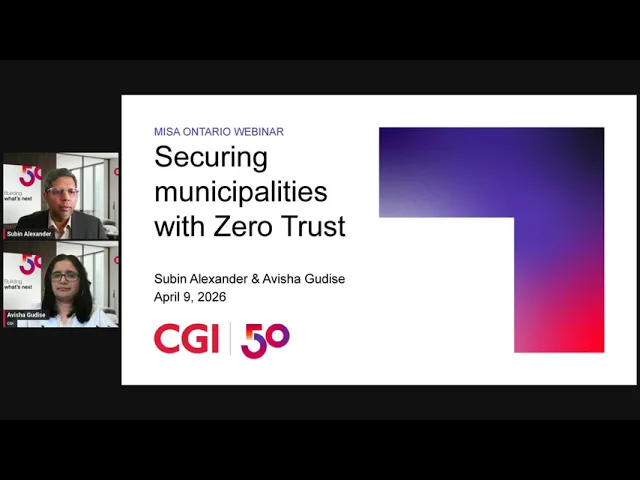
To explore these concepts in more depth — including practical examples, frameworks, and implementation guidance — watch the full webinar:

Watch the full discussion