

From theory to reality: agility in the field

Whether driven by digital transformation or cultural change, organizational transformation has become the norm. The ability to lead change in an agile way is therefore a critical success factor. Yet the implementation of frameworks such as the Scaled Agile Framework Enterprise (SAFe) often reveals gaps between theory and real-world application.

This is where agile change leadership becomes essential. Organizations face growing complexity, change fatigue among employees, and the need to reconcile two complementary approaches: a structured methodological approach focused on stability and efficiency, and a field-driven approach grounded in experimentation and adaptation.

SAFe: an agile train that goes beyond organizational silos

SAFe provides a detailed blueprint for coordinating value creation across complex organizations. Its structured approach to scaling agility relies on Agile Release Trains, true value networks that break down hierarchical silos. However, this structure requires significant changes in IT and business functions, including redefining roles, responsibilities and practices.

Adopting SAFe introduces new roles, methods and habits. IT and business leaders must rethink collaboration models, and employees must adapt to new expectations and responsibilities. The real challenge lies not in deploying the SAFe framework itself, but in integrating it seamlessly across the organization.

Living change rather than undergoing it


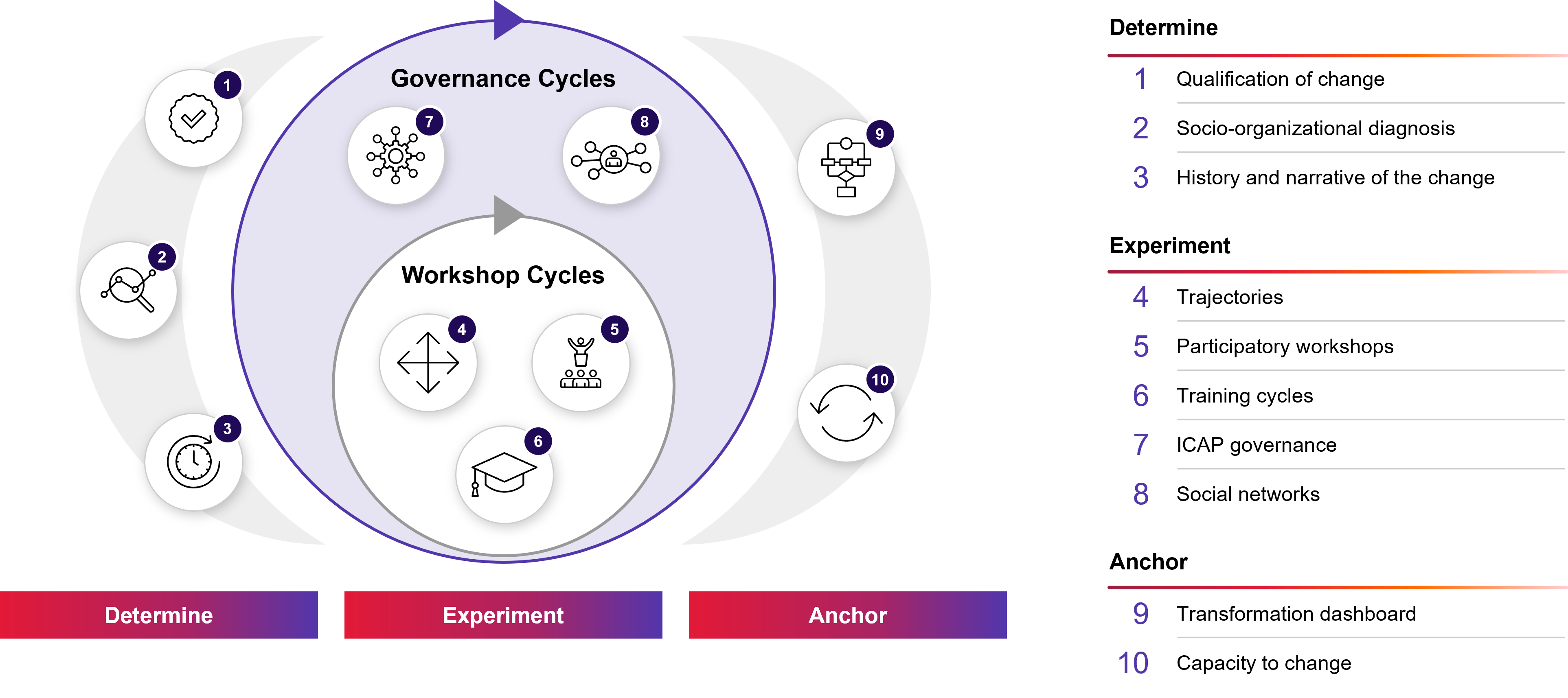
Agile change model

Figure 1: The agile change model (Autissier and Moutot, 2015)

Traditional change management approaches based on linear planning and top-down communication are no longer sufficient. They often fail to mobilize stakeholders fully, overlook field feedback, and do not adequately address managerial resistance.

A more effective approach involves adopting an experience-based change management model that applies agile principles. This model includes three dynamic phases:

  • Definition: framing change collaboratively with stakeholders.
  • Experimentation: testing solutions in real-world conditions and measuring their impact.
  • Implementation: stabilizing new practices and embedding them sustainably.

Inspired by the work of Autissier and Moutot, this model moves away from treating change as an imposed project and instead emphasizes co-creation, collaboration and experimentation. Change becomes an ongoing process that stakeholders continuously integrate rather than passively endure.

The narrative approach: restoring meaning and fostering engagement

Change fatigue is real. Organizations undergoing multiple transformations often lose sight of the original purpose behind change. The narrative approach restores meaning by linking strategy with lived experience. It creates momentum and direction by leveraging individual and collective stories to:

  • give change meaning aligned with employees’ values and experiences;
  • build consensus and engagement by incorporating employee narratives;
  • identify leverage points and resistance by surfacing hidden fears and beliefs;
  • define a shared vision through co-creating a collective change story.

In practice, this approach transforms monologue into dialogue, encouraging stakeholders to become active participants rather than passive recipients of change.

Prerequisites for agile change

An agile approach to change requires:

  • availability and strength of facilitators;
  • participatory forums and activities;
  • time and resource investment for pilot initiatives;
  • adoption of a shared vision, even as targets evolve.

Leading change: the role of change squads

Agile transformation requires specialized competencies. Leading organizations have established change squads: cross-functional teams composed of agile coaches, change advisors, and communication and organizational development specialists.

These squads act as transformation catalysts. They facilitate workshops, measure adoption, identify resistance points, and maintain alignment between the methodological framework and field realities. They embody collaboration, adaptability and transparency.

A flexible trajectory toward the target

In an environment where change is constant, success is no longer about reaching a fixed destination, but about following a trajectory — experimenting, adapting, and continuously restoring meaning. Organizational change management must balance structured processes with flexible experimentation to enable sustainable transformation.

Agile change leadership redefines transformation as an ongoing process rather than a one-time event. By combining experimentation with storytelling, structure with human orientation, organizations can bridge theory and field application to foster resilience, engagement and sustainable performance.

CGI helps organizations become more agile and translate frameworks into tangible outcomes. To learn how our experts can support your next transformation, contact our organizational change leadership team.

References

  • Autissier, D., Derumez, C., and Johnson, K. Neo Change, EMS Editions, 2024.
  • Autissier, D., and Moutot, J.-M. (2015). Agile Change: Transform Quickly and Sustainably. Paris: Dunod.
  • Kotter, J. P. XLR8, Harvard Business Review Press, 2014.