

AI in the organization: Wider attack surface, higher risk
Modern artificial intelligence architectures, specifically autonomous agents and large-scale generative models, do not merely introduce new risks; they amplify systemic architectural weaknesses.
By expanding the attack surface and introducing emergent, unpredictable vulnerabilities, these technologies have complicated the security landscape to a degree that traditional oversight teams find difficult to manage.
What is AI Security at CGI?
CGI helps organizations build on a strong foundation of regulatory compliance and governance, while enabling the agility needed to keep pace with rapid AI advancements, leveraging leading vendor innovations to drive stronger outcomes in the most secure way.
From AI governance to AISecOps
We provide security services across the full AI lifecycle, translating your investments into results.
Ready for generative and agentic AI
We help you secure training data and foundation models, as well as prompts, pipelines, inference APIs, and agent exchange protocols (MCP/A2A).
Start, accelerate, or reset: Get help from CGI to address the new wave of security concerns for the full AI lifecycle
Whether your current challenge is insufficient governance, shadow AI, data leak prevention (DLP), or else, CGI security and AI experts are teaming with key vendors to help you address what is keeping you awake at night. Enable secure innovation, reassure the C-suite, and stimulate the board of directors with proven return on their AI investments.
Discover and govern |
Secure data and pipelines |
Secure models and runtime |
Test and validate |
Monitor and respond |
| Goal Mitigate “Shadow AI” by creating a dynamic inventory of all sanctioned and unsanctioned models. |
Goal Ensure privacy-preserving data handling and the integrity of the training environment. |
Goal Protect the inference layer through advanced LLM firewalls and interoperable security protocols. |
Goal Move from “good intentions” to “verifiable safety” through rigorous pre-release stress testing. |
Goal Implement specialized AI Detection and Response (AIDR) to manage the unique lifecycle of AI threats. |
| Outcome Implementation of automated risk ratings, real-time usage controls, and a unified security posture that aligns AI adoption with corporate policy and brand reputation. |
Outcome Automated detection of sensitive data within pipelines and the enforcement of rigid configurations to prevent the contamination or unauthorized exfiltration of intellectual property. |
Outcome Rigorous inspection of prompts (inputs) and completions (outputs) while leveraging Model Context Protocol (MCP) to secure autonomous Agent-to-Agent (A2A) communication. |
Outcome Execution of both manual and automated red-teaming exercises to identify vulnerabilities, bias, and adversarial weaknesses, ensuring every model is "audit-ready" from day one. |
Outcome Proactive monitoring for behavioral anomalies and model drift, enabling rapid intervention and automated remediation of runtime incidents. |
Many organizations have been “building the plane as they fly it”, adding bits and pieces of artificial intelligence and machine learning (AI/ML) to their environment through either software development projects or the activation of new features in vendor products. In many cases, IT teams are uncovering the threats while running the technology, and regulations are coming out when LLMs and agentic applications are in production and fully part of the IT ecosystem. Consequently, security leaders must rapidly re-evaluate risks, redefine strategies, and adapt processes to include non-human identities (NHI) and control data access.

Industries: Acting fast to address new risks and enable CISOs to fill security gaps
Industries are adapting to include AI, generative AI, and agentic usage in their guidelines. Canadian examples include OSFI-23 Model Risk Management in Financial Services and Health Canada’s pre-market guidance for ML-enabled medical devices.

Provincial and local governments: Actively building regulations to set AI usage guidelines
Consider Ontario’s Responsible Use of AI Directive, Quebec’s Law 25, and Newfoundland and Labrador’s Public Procurement AI Mandate, that not only impact public servants, but also companies selling services to governments and guiding technology choices.

Federal government: Jumpstarting a more agile, security-focused national framework for AI
The AI Strategy Task Force is led by the Minister of Artificial Intelligence and Digital Innovation. Their initial “Engagements on Canada’s next AI Strategy” public consultation reached 11,300 participants, enlightening the next framework discussions.
Read Canada’s AI strategy inputs
Why we care: CGI’s Responsible Use of AI Framework
When we started integrating artificial intelligence tools into our technology stack, machine learning was not as common usage as it is nowadays. One thing is sure: CGI leadership has always been wary about any risks, be it to the company or to our clients.
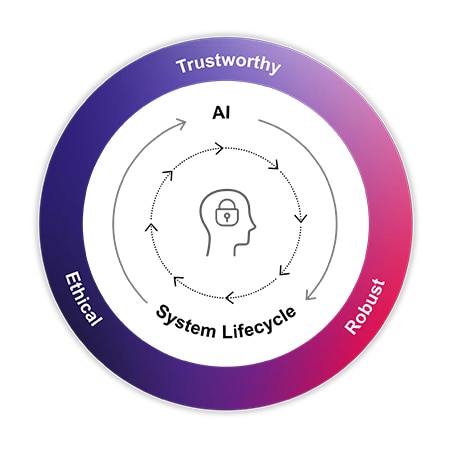
It is therefore no surprise that over the years, our Management Foundation has been enriched with a stellar Responsible Use of AI Framework to equip the taskforce with clear principles, processes, and tools that align with human values and individual rights, for safe adoption of all AI technologies.
All AI services and solutions that CGI designs, builds or operates must follow three principles: Robust – Ethical – Trustworthy.
Explore CGI’s Responsible AI approach